


The Comprehensive Anti-Phishing Protection Checklist for Businesses in 2026
- Simon Raine
- Jun 11
- 12 min read
Updated: 4 days ago
With AI generated phishing attacks surging by 14 times in 2026, the margin for error in your digital defences has effectively vanished. Establishing robust anti-phishing protection for businesses is no longer just a technical preference; it's a fundamental requirement for operational stability. It's understandable if you feel overwhelmed by the shifting requirements of DMARC protocols or the constant worry that a single employee's misplaced click could lead to a devastating financial loss. You're certainly not alone in finding this technical landscape increasingly difficult to manage.
This guide provides a definitive roadmap to mastering your security posture, ensuring your organisation remains secure against even the most sophisticated AI driven threats. By following this structured checklist, you'll gain the clarity needed to harden your infrastructure and empower your team. We will explore the essential technical hardening steps, strategies for building a resilient workforce, and the precise actions required to align your operations with the latest UK standards, such as Cyber Essentials and the Cyber Security and Resilience Bill.
Key Takeaways
Understand why traditional email filters struggle against AI driven spear phishing and how a multi layered strategy restores operational control.
Master the technical foundation of email authentication by correctly implementing SPF, DKIM, and DMARC to shield your corporate domain.
Transform your workforce into a resilient final line of defence through continuous security awareness training and behavioural monitoring.
Follow a definitive checklist for anti-phishing protection for businesses that includes hardening technical settings and implementing operational safeguards.
Discover how strategic attack surface reduction minimises potential vulnerabilities and strengthens your organisation's overall security posture.
Table of Contents
Understanding the 2026 Phishing Landscape: Why Traditional Filters Fail
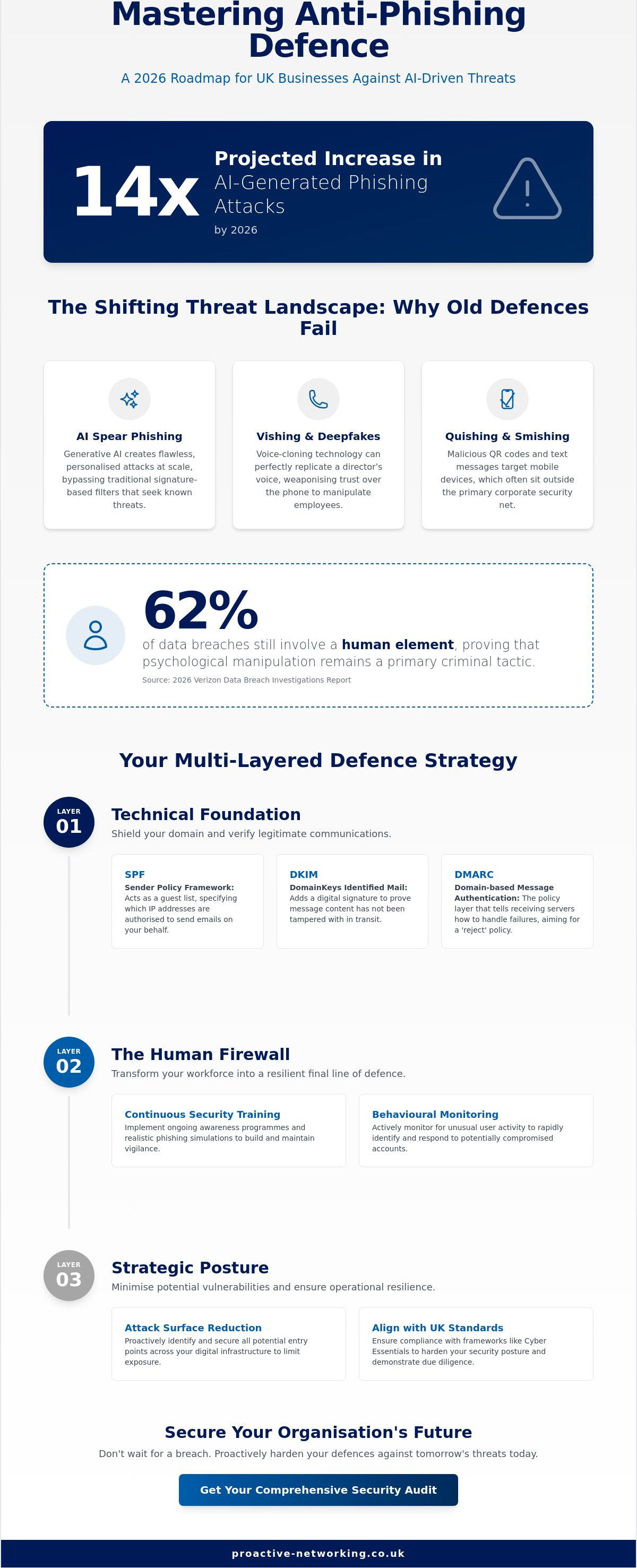
Effective anti-phishing protection for businesses has evolved into a comprehensive, multi layered strategy that integrates technical hardening with behavioural training. It's no longer sufficient to rely on a single defensive layer. The threat landscape has shifted dramatically from spray and pray tactics to highly targeted, AI augmented spear phishing. These modern attacks are designed to bypass traditional security perimeters by exploiting the trust established in everyday business interactions. By June 2026, the volume of AI generated phishing attacks has increased by 14 times, making the digital environment more hostile than ever before.
Standard signature based spam filters, which were once the cornerstone of email security, are now largely inadequate. These filters work by matching incoming messages against a database of known malicious patterns. However, understanding phishing techniques in 2026 reveals that attackers now use generative models to create unique content for every interaction. Since the code and text are never repeated, there is no signature for traditional software to detect. This leaves businesses exposed to vishing and deepfake technology that can perfectly replicate a director's voice during a phone call. According to the 2026 Verizon Data Breach Investigations Report, 62% of breaches still involve a human element, proving that psychological manipulation remains a primary goal for criminals.
The Rise of Generative AI in Social Engineering
Generative AI has removed the linguistic barriers that once made phishing easy to spot. Grammatical mistakes and strange formatting have been replaced by a flawless mimicry of corporate styles and internal jargon. Attackers now launch industrial scale personalised campaigns that target hundreds of employees simultaneously with bespoke lures. The speed of these attacks is particularly concerning. What used to take a criminal group weeks of manual research can now be automated in seconds. AI driven phishing represents the single greatest threat to SME email security in 2026, which is why Business With AI Strategist provides the strategic consultancy needed to help teams implement robust defences against these evolving risks.
Beyond the Inbox: Smishing and Quishing
Security must now extend to every device your team uses. Quishing, the use of malicious QR codes, has become a frequent tactic in both digital invoices and physical office environments. When an employee scans a code, they're often directed to a sophisticated spoof site on their mobile phone. These devices frequently sit outside the primary corporate security net, making them prime targets for smishing. A modern workforce requires cross platform protection that secures the user, not just the inbox. Relying on desktop filters alone creates a dangerous gap in your perimeter that attackers are eager to exploit.
Hardening Your Technical Infrastructure: The Authentication Foundation
Establishing a resilient technical foundation is the first priority for anti-phishing protection for businesses. Without it, even the most vigilant employees are left vulnerable to spoofing. The core of this defence lies in what experts call the 'holy trinity' of email authentication. These protocols work in tandem to verify that messages appearing to come from your domain are legitimate. Implementing these standards is a critical component of multi-layered cyber security for SMEs, as it ensures your brand's reputation isn't weaponised against your clients or partners.
Implementing SPF, DKIM, and DMARC Correctlty
SPF (Sender Policy Framework) acts as a guest list, specifying which IP addresses are authorised to send mail on your behalf. This prevents simple IP spoofing where attackers pretend to be you. DKIM (DomainKeys Identified Mail) adds a digital signature to every outgoing message, providing cryptographic proof that the content hasn't been tampered with in transit. Finally, DMARC (Domain-based Message Authentication, Reporting, and Conformance) provides the essential policy layer. It tells receiving servers exactly how to handle mail that fails these checks. As of June 2026, DMARC has been formalised as a Proposed Standard through RFC 9989, making it an authoritative requirement rather than an optional configuration. Following the NIST phishing protection guidelines, organisations should aim for a 'reject' policy to ensure fraudulent emails never reach their intended target.
Configuring these records can be complex and prone to error. Professional managed domain hosting simplifies this landscape by ensuring your SPF, DKIM, and DMARC settings are monitored and maintained correctly. This oversight prevents configuration drift and ensures high deliverability whilst maintaining strict security. It provides the quiet competence required to manage a business domain in a hostile digital environment.
Advanced Sign-in Protection and Identity Management
Robust sign-in protection is equally vital for comprehensive anti-phishing protection for businesses. Microsoft research indicates that multi-factor authentication (MFA) can block over 99% of account compromise attacks. In 2026, we've seen a shift towards phishing-resistant MFA, such as FIDO2 security keys, which eliminate the risks associated with traditional SMS codes. Conditional access policies add another layer of control by analysing user behaviour and location in real-time, blocking access if a login attempt appears anomalous. Identity is the new perimeter in a remote-first business world. By securing the point of entry, you provide a stable environment where your team can work without the constant threat of account takeover.
Empowering the Human Firewall: Training and Behavioural Security
The most robust technical protocols can still be circumvented by a well crafted social engineering lure. Whilst infrastructure hardening is essential, employees remain the final line of defence when an AI generated threat manages to reach the inbox. According to the 2026 Verizon Data Breach Investigations Report, 62% of data breaches involve a human element, highlighting that psychological manipulation is often more effective than technical exploitation. Establishing a no blame culture is fundamental to modern anti-phishing protection for businesses. When an employee feels safe reporting a potential error, your security team can neutralise a threat in minutes rather than discovering a compromise weeks later. This transparency is a core recommendation within UK government cyber security guidance, which emphasises the need for organisational resilience through open communication.
Effective Security Awareness Training Programmes
Continuous education is far more effective than annual tick box exercises. Modern training programmes should utilise micro learning modules that deliver punchy, relevant information in five to ten minute bursts, preventing information overload. These sessions must be tailored to the specific risks faced by different departments. For instance, finance teams require deep dives into business email compromise (BEC) and mandate fraud, whilst HR departments need to be wary of malicious attachments disguised as CVs. By making the content highly specific to their daily tasks, you ensure that security remains a conscious part of their professional behaviour.
Simulated Phishing: Testing Resilience in Real-Time
Safe simulations allow you to measure your organisation's actual risk profile without exposing the business to real danger. These tests should mimic current 2026 trends, such as "Quishing" or deepfake voice messages, to ensure your team is prepared for the latest tactics. Integrating these simulations with advanced threat detection services allows for real time monitoring of how users interact with suspicious content. The data gathered from these exercises is invaluable for identifying "serial clickers" who may require additional, supportive training. Rather than being a punitive measure, these simulations provide a structured way to build confidence and competence across the entire workforce, ensuring that your human firewall is as resilient as your technical one.
Moving from strategy to implementation requires a structured approach that aligns with established UK standards. Integrating anti-phishing protection for businesses into your wider compliance framework, such as Cyber Essentials or ISO 27001, ensures that security isn't a standalone project but a core business function. This alignment is particularly important given the UK Cyber Security and Resilience Bill, which mandates stricter incident reporting and supply chain oversight. A comprehensive checklist provides the steady, methodical progress needed to secure a complex environment without overwhelming your internal resources.
For many organisations, the transition to a hardened posture begins with a policy of zero trust. This involves moving beyond simple detection and towards active prevention. By aligning your internal policies with the requirements of Cyber Essentials and GDPR compliance, you create a verifiable standard of protection that reassures both clients and insurers. This structured approach replaces uncertainty with a sense of order and strategic foresight.
Technical Hardening Checklist
Audit all active email domains: Verify that every domain and subdomain is compliant with SPF, DKIM, and DMARC. To achieve maximum protection, your DMARC policy must eventually be set to "p=reject" to ensure unauthorised mail is blocked entirely.
Prioritise sign in protection: Enable phishing resistant MFA on all business critical accounts. Administrative and finance roles should be the first to receive this hardening to prevent high value account takeover.
Deploy EDR or XDR solutions: These advanced tools monitor for malicious behaviour post click. They provide an essential safety net if a user inadvertently interacts with a sophisticated AI driven threat.
Operational and Policy Checklist
Implement dual authorisation: Establish a mandatory process where two independent approvals are required for all financial transfers. This simple operational change effectively neutralises the risk of financial loss from Business Email Compromise.
Simplify user reporting: Deploy a "report message" button directly within the email client. This empowers your team to act as active participants in your defence and allows security staff to isolate suspected breaches rapidly.
Review business continuity plans: Ensure your recovery processes include specific phishing scenarios. A documented process for isolating infected devices and restoring data from local or cloud backups is vital for business resilience.
Assess supply chain risk: Verify that all third party vendors meet your minimum security standards. Your anti-phishing protection for businesses is only as strong as the weakest link in your digital ecosystem.
Conducting quarterly phishing simulations with post event debriefs ensures these technical and operational controls remain effective. These exercises provide the data needed to refine your strategy and maintain a high tier standard of security across the organisation.
Strategic Cyber Security: Moving Beyond Basic Anti-Phishing
Anti-phishing protection for businesses shouldn't exist in a vacuum. It's a critical element of a wider managed IT support strategy that seeks to secure every facet of your digital operations. By focusing on Attack Surface Reduction, you proactively close the gaps that attackers exploit, making your organisation a much harder target. This strategic approach is particularly vital for firms in the legal and finance sectors, where the stakes of a breach involve both heavy financial penalties and irreparable reputational damage. Proactive Networking acts as a sophisticated partner in this process, simplifying the technical landscape so you can focus on your core operations.
Integrating EDR and XDR for Multilayered Defence
Even with the best training, mistakes happen. Endpoint Detection and Response (EDR) provides a vital safety net by monitoring device behaviour and blocking malicious processes the moment a link is clicked. Extended Detection and Response (XDR) takes this further by correlating data across your email, network, and cloud environments to spot complex, multi stage attacks. It allows for a coordinated response that traditional antivirus software simply cannot match. XDR is the future of proactive business protection.
Achieving Compliance: Cyber Essentials and ISO 27001
Robust anti-phishing measures are a core requirement for achieving Cyber Essentials certification. This standard demonstrates to your clients and partners that you've implemented the essential technical controls to stay secure. For those looking to establish a premium service standard, ISO 27001 offers a long term framework for managing risk and building international trust. These certifications don't just protect your data; they enhance your business reputation in a competitive market. Discover how we can organise your cyber security compliance to protect your future.
Managing these layers of protection requires a structured and organised approach. By partnering with a seasoned expert who understands the nuances of anti-phishing protection for businesses, you gain the strategic foresight needed to stay ahead of evolving threats. You don't have to face these technical challenges alone. We provide the calm, steady leadership required to ensure your organisation remains a resilient and trustworthy guardian of its own data.
Securing Your Organisation's Future Against Evolving Threats
Implementing comprehensive anti-phishing protection for businesses is a journey towards total operational resilience. By combining the technical rigour of SPF, DKIM, and DMARC with a continuous programme of employee education, you create a defensive posture that's both robust and adaptive. These measures do more than just block malicious emails; they foster a culture of vigilance and ensure your business remains compliant with essential UK standards like Cyber Essentials and ISO 27001.
Proactive Networking brings over 25 years of experience in SME IT support to your side. We specialise in delivering high tier security solutions, from advanced EDR and XDR platforms to complete email protection. Our team acts as a dedicated guardian for your operations, simplifying the path to compliance whilst protecting your most valuable data assets. It's about establishing a sense of order and control in an increasingly complex digital world.
Take the first step towards a more secure environment today. Secure your business with a professional cyber security audit and gain the peace of mind that comes from expert oversight. With the right partner, navigating the complexities of the 2026 threat landscape becomes a manageable and empowering process.
Frequently Asked Questions
What is the best anti-phishing protection for a small business?
The most effective strategy is a multi layered defence that combines technical hardening with continuous staff education. You should implement the "holy trinity" of email authentication, SPF, DKIM, and DMARC, alongside robust multi-factor authentication. This technical foundation, when paired with a resilient human firewall, provides the comprehensive anti-phishing protection for businesses needed to survive in the 2026 threat landscape.
Does Microsoft 365 include enough anti-phishing protection out of the box?
Standard Microsoft 365 subscriptions provide foundational filtering, but they often require manual configuration to reach peak effectiveness. For protection against sophisticated AI driven spear phishing, businesses typically need to move beyond default settings. This involves implementing advanced sign in protection and potentially integrating EDR or XDR solutions to monitor for malicious behaviour that bypasses initial filters.
How often should we run phishing simulations for our staff?
Running simulations on a quarterly basis is considered the industry standard for maintaining high levels of vigilance without causing training fatigue. These exercises should be followed by a post event debrief to reinforce positive behaviours. High value departments, such as finance or HR, may benefit from more frequent, targeted simulations that reflect the specific lures they are likely to encounter in their daily roles.
Can AI really help protect my business from phishing attacks?
Behavioural AI is a critical tool for identifying anomalies in communication patterns that signature based filters often miss. It can detect subtle changes in tone, unusual login locations, or suspicious link structures in real time. By utilising AI driven threat detection, your organisation gains a proactive shield that adapts to new phishing variants as they emerge, providing a more stable and secure environment.
What should an employee do if they accidentally click a phishing link?
The employee should report the incident to the IT support team immediately and disconnect their device from the network to prevent lateral movement. Speed is the most vital factor in containing a potential breach. Following a "no-blame" policy ensures that staff feel comfortable coming forward quickly, allowing your security team to isolate the threat and initiate incident response protocols before significant damage occurs.
Is DMARC mandatory for UK businesses in 2026?
Whilst not a legal requirement for every sector, DMARC is effectively mandatory for ensuring email deliverability in 2026. Major providers like Google and Microsoft now strictly enforce authentication standards for all senders. Furthermore, DMARC is a core component of the Cyber Essentials scheme, making it a prerequisite for any business seeking government contracts or demonstrating a high tier security standard to their clients.
How does anti-phishing protection impact our cyber insurance premiums?
Insurers now view robust anti-phishing protection for businesses as a fundamental requirement for coverage. Demonstrating that you have implemented MFA, email authentication, and regular staff training can lead to more favourable terms and lower premiums. Conversely, failing to meet these basic security benchmarks may result in higher costs or even the refusal of a policy, as insurers seek to minimise their exposure to Business Email Compromise.
What is the difference between anti-spam and anti-phishing?
Anti-spam technology is designed to block unsolicited bulk messages that are primarily a nuisance. Anti-phishing, however, focuses on detecting malicious intent and psychological manipulation. Whilst spam filters look for volume and known keywords, anti-phishing solutions analyse sender identity and message context to prevent data theft and financial fraud. Both are necessary, but anti-phishing is the more critical component for operational security.


Comments