


The Comprehensive Guide to Multi-Layered Cyber Security for SMEs in 2026
- Simon Raine
- May 30
- 12 min read
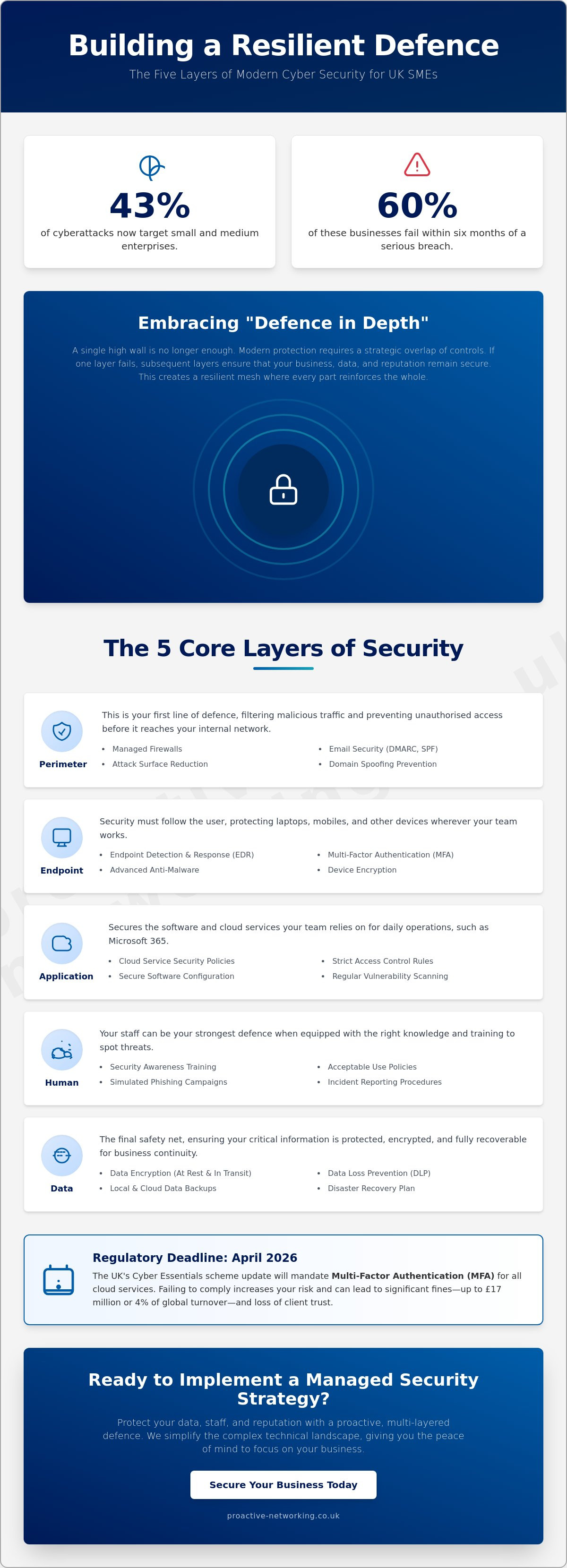
Did you know that 43% of cyberattacks now target small and medium enterprises, and 60% of those businesses fail within six months of a serious breach? This statistic represents a sobering reality for business owners who feel the weight of protecting remote teams whilst facing increasingly sophisticated ransomware. Implementing robust multi layered cyber security for smes is no longer a luxury; it's a fundamental requirement for operational survival in 2026.
You likely feel the mounting pressure from clients to prove your resilience, especially with the April 2026 update to the Cyber Essentials scheme making multi factor authentication mandatory for all cloud services. We understand that managing these technical shifts feels daunting when your primary focus is on growth. This guide provides a clear roadmap for your security investment, showing you how to build a sophisticated, overlapping defence strategy that protects your data, staff and reputation. We'll explore how to ensure your data is always recoverable, giving you the confidence to pass your next audit and the peace of mind to focus on your core business.
Key Takeaways
Understand why a strategic overlap of physical, technical and administrative controls is the only way to achieve genuine "Defence in Depth" against modern threats.
Learn how to transition from basic antivirus to advanced Endpoint Detection and Response (EDR) to secure your staff and reduce your attack surface.
Discover how frameworks like Cyber Essentials and ISO 27001 provide a structured roadmap to satisfy client demands and ensure regulatory compliance.
Recognise the vital role of the "Recovery Layer" by pairing local and cloud data backups to ensure your business remains operational regardless of the challenge.
Find out how to implement comprehensive multi-layered cyber security for smes through a managed strategy that simplifies complex technical landscapes.
Table of Contents
The Fundamentals of Multi Layered Cyber Security for UK SMEs
Modern protection is no longer about building a single high wall. Instead, it involves a strategic overlap of physical, technical and administrative controls. For British businesses, implementing multi layered cyber security for smes creates a resilient environment where one failed control doesn't lead to a total breach. This approach is often described as Defense in Depth, a concept that ensures multiple redundant measures protect your most sensitive assets. In 2026, where threats are automated and relentless, this redundancy is your greatest asset.
Traditional perimeter only defences have become obsolete. With hybrid workforces accessing data from various locations, the office wall has effectively vanished. Security must now follow the user and the data, rather than staying fixed to a physical building. A proactive strategy ensures that even if an attacker breaches your outer network, they encounter subsequent barriers that prevent them from reaching your core data. This layered approach ensures that your operations remain stable even under pressure.
Why a Single Defence Is No Longer Sufficient
Sophisticated phishing and AI driven social engineering have made it easier for attackers to compromise a single point of entry. It's a sobering fact that one stolen password can bypass an entire security system if that system lacks depth. For a UK SME, a single point failure isn't just a technical glitch; it's a reputational disaster. Clients in sectors like legal and finance now demand proof of resilience before signing contracts. A breach often results in heavy fines under the Cyber Security and Resilience Bill, potentially reaching £17 million or 4% of global turnover, which can end a business overnight.
Defining the Layers: A Holistic Framework for Resilience
A robust strategy organises security into five distinct but communicative layers:
Perimeter: Managed firewalls and attack surface reduction to block external threats.
Endpoint: Protection for laptops and mobile devices through EDR and anti malware.
Application: Securing the software and cloud tools your team uses daily, including Microsoft 365.
Human: Training staff to recognise and neutralise social engineering and phishing attempts.
Data: Encryption and backups that act as the final safety net for business continuity.
These layers operate independently yet share intelligence to create a unified front. By adopting multi layered cyber security for smes, you transform your IT environment from a fragile box into a resilient mesh. The modern mesh approach to SME security ensures that every individual control informs the wider system, making a successful attack prohibitively expensive and difficult for intruders.
Securing the Perimeter and Protecting Your Endpoints
Establishing the first line of defence is a critical step in building multi layered cyber security for smes. Whilst the traditional office boundary has shifted, the need for managed firewalls and attack surface reduction remains paramount. These technical controls act as digital filters, scrutinising incoming traffic and blocking known threats before they can interact with your internal systems. By proactively reducing the number of entry points an attacker can exploit, you significantly lower the risk of a successful breach and ensure your network remains a controlled environment.
Protecting the sign in process is equally vital. Multi factor authentication is no longer an optional extra; it is a mandatory requirement under the April 2026 Cyber Essentials update for all business critical systems. This layer ensures that even if a password is leaked, your data remains inaccessible to intruders. It is a simple yet powerful tool that blocks the vast majority of account compromise attacks, providing a sense of security for teams working across various locations. By securing the identity layer, you create a robust foundation for the rest of your technical defences.
Fortifying the Network Edge and Email Gateways
Email remains the primary vector for cyberattacks, making email security a non negotiable layer. Implementing managed domain hosting that includes DMARC, SPF and DKIM security is essential to prevent domain spoofing and protect your brand’s reputation. These protocols verify that an email truly originates from your organisation, stopping criminals from impersonating your staff. Combined with advanced anti phishing and anti spam filters, these measures ensure that malicious links and attachments never reach your employees' inboxes. High quality resources like this guide on Cybersecurity for Small Business emphasise that securing communication channels is a cornerstone of operational safety. Additionally, resilient broadband and backup lines provide the infrastructure stability needed to maintain these security layers without interruption.
Advanced Endpoint Detection and Response (EDR) and XDR
Traditional antivirus software is no longer sufficient for the sophisticated threats of 2026. Legacy systems rely on signatures of known viruses, which means they are often one step behind new, zero day attacks. Modern protection requires Endpoint Detection and Response (EDR). This technology monitors individual devices, such as laptops and mobile phones, for suspicious behaviour rather than just matching files against a list. For businesses seeking even greater visibility, Extended Detection and Response (XDR) integrates data across multiple platforms, including email and cloud environments. This cross platform approach allows for proactive monitoring that identifies anomalies amongst legitimate user actions. Protecting your remote first workforce requires this level of detail, ensuring that every device remains a secure asset. If you are looking to upgrade your current defences, our team can help you implement tailored cyber security solutions that grow with your business.
Addressing the Human Element and Regulatory Compliance
Whilst technical barriers like firewalls and EDR are essential components of multi-layered cyber security for smes, they are only as effective as the people who navigate them. The "Human Layer" is frequently the most vulnerable point in any organisation, yet it remains one of the least funded areas of security. True resilience requires shifting from viewing security as a collection of software licenses to seeing it as an ingrained company culture. When security is treated as a core business value, it transforms from a technical hurdle into a competitive advantage.
GDPR compliance serves as a vital framework for this cultural shift. It isn't merely about avoiding the potential £17 million fines mentioned earlier; it's about structuring data protection policies that ensure accountability and transparency. By aligning your internal processes with these regulations, you create a structured environment where data privacy is prioritised at every level of the business. This approach ensures that security isn't an afterthought but a fundamental part of your daily operations.
Empowering Staff Through Cyber Awareness Training
Regular, bite-sized training sessions are far more effective than annual tick-box exercises. When your team understands the mechanics of modern threats, they become an active part of your defence strategy. Using simulated phishing attacks allows you to identify high-risk areas within the business without the danger of a real breach. It’s also vital to establish clear, blame-free reporting procedures. If an employee clicks a suspicious link, they must feel confident reporting it immediately to ensure rapid containment. The NCSC's Small Business Guide provides excellent foundational advice on establishing these internal behaviours and reporting lines.
Achieving Accreditation: Cyber Essentials and ISO 27001
For many UK SMEs, regulatory compliance and industry certifications provide the necessary roadmap for security investment. Cyber Essentials is an excellent starting point, focusing on five fundamental technical controls that protect against the most common internet-based threats. In contrast, ISO 27001 is a more comprehensive international standard that governs broader risk management and information security systems. Choosing the right path depends on your sector and client requirements. Achieving these accreditations builds significant trust amongst your clients and supply chain partners, proving you take their data security seriously. For those in the legal or finance sectors, detailed guidance on ISO 27001 and GDPR compliance can help bridge the gap between basic protection and enterprise-grade resilience. Ultimately, a robust approach to multi-layered cyber security for smes ensures your business remains a trusted partner in an increasingly cautious market.
Building Resilience Through Business Continuity and Data Recovery
The "Recovery Layer" serves as the final safety net in a robust defence strategy. While previous sections focused on blocking and detecting threats, this layer addresses the reality that no system is entirely infallible. If a sophisticated attack manages to bypass your perimeter and endpoint controls, your ability to restore operations determines your survival. Resilience is not just about stopping the breach; it’s about ensuring your business can keep functioning whilst the incident is contained.
For many UK organisations, implementing multi-layered cyber security for smes involves moving beyond basic data saving towards true business continuity. This requires a strategic coexistence of local and cloud data backups. Local copies allow for the rapid restoration of individual files, whilst cloud-based versions provide a secure, offsite environment that remains unaffected by local hardware failures or physical disasters. Regular testing is essential to confirm these systems work as intended, providing the peace of mind that your data is always recoverable.
Managed Data Backups: Local vs Cloud Resilience
We advocate for the 3-2-1 backup rule to ensure maximum protection. This industry standard requires keeping three copies of your data, stored on two different types of media, with at least one copy kept offsite. In 2026, the use of immutable cloud backups has become essential. These backups are stored in a write-once-read-many (WORM) format, meaning they cannot be altered or deleted, even if a ransomware actor gains administrative access to your network. Managed backup services further enhance this by taking the burden of daily verification and monitoring off your shoulders, ensuring every data point is healthy and ready for restoration.
Disaster Recovery Planning and 4-Hour Recovery Objectives
A comprehensive Business Continuity Plan (BCP) goes beyond simple data storage; it defines how your business operates during a crisis. Central to this are two metrics: Recovery Time Objective (RTO), which is the duration of time a business process must be restored after a disaster, and Recovery Point Objective (RPO), which defines the maximum age of files that must be recovered. For modern SMEs, a 4-hour recovery objective is the gold standard for avoiding permanent closure following a major incident. This involves having a documented, step-by-step response that includes isolating affected systems and activating standby cloud environments. If you are unsure whether your current systems can meet a 4-hour recovery target, you can speak with our business continuity specialists to review your strategy and ensure your operations are truly resilient.
Implementing a Managed Security Strategy with Proactive Networking
Implementing a sophisticated defence strategy doesn't have to be an overwhelming technical burden for your team. Proactive Networking Ltd acts as a dedicated guardian, simplifying the intricate layers of modern protection to ensure your operations remain secure and efficient. With 25 years of experience in SME IT support and security, we understand the specific challenges British businesses face in an increasingly hostile digital environment. Our approach focuses on moving beyond reactive fixes to a model of constant vigilance. We've mastered the technical complexities so you don't have to.
By choosing a managed strategy, you gain access to enterprise-grade tools and expertise without the need for an expensive in-house department. We provide a fully managed security stack that monitors your environment in real time, whilst our proactive stance allows us to identify and neutralise potential issues before they escalate into costly downtime or data loss. Ultimately, it’s about providing you with the peace of mind that your data, staff, and reputation are protected by a partner who anticipates threats before they arrive. This comprehensive oversight is the cornerstone of effective multi-layered cyber security for smes.
The Proactive Approach to Infrastructure Management
We believe that security should be woven into the very fabric of your IT support rather than treated as a separate add-on. Our methodology focuses on continuous attack surface reduction, ensuring that your network entry points are strictly controlled and monitored. We don't just wait for something to break; we actively maintain and monitor your systems to prevent vulnerabilities from appearing in the first place. For a broader perspective on how we manage these technical environments, we invite you to view our Managed IT Support guide. This resource explains how we align infrastructure management with your long-term business goals.
Specialist Security for Legal, Finance and Education
Certain sectors require a higher level of scrutiny due to the sensitive nature of the data they handle. We specialise in providing bespoke compliance consultancy for Solicitors, Barristers, and finance professionals who must adhere to strict regulatory standards. Our team is particularly skilled in managing company data mergers and separations, ensuring that transitions for growing firms are handled with surgical precision and absolute security. Whether you are navigating the complexities of ISO 27001 or ensuring sector-specific regulatory adherence, we provide the steady leadership needed to maintain compliance. By partnering with us, you ensure that your multi-layered cyber security for smes is not just a general solution but a tailored shield designed for your specific industry requirements.
Building a Resilient Future for Your Organisation
We have explored how the transition from legacy antivirus to advanced EDR, combined with a focus on the human layer and robust recovery objectives, creates a formidable defence. True resilience in 2026 isn't achieved through a single product but through the strategic integration of technical controls and a culture of constant cyber awareness. Implementing multi-layered cyber security for smes ensures your business can withstand sophisticated threats whilst maintaining the trust of your most valuable clients.
As ISO 27001 and Cyber Essentials specialists with over 25 years of experience, we provide the expert guidance needed to navigate these technical landscapes. We offer specialised support for the legal and finance sectors, ensuring your compliance is as robust as your digital defence. Secure your business with a professional cyber security audit from Proactive Networking to identify vulnerabilities before they can be exploited. You now have the roadmap to protect your operations; taking this proactive step today ensures your business remains secure, compliant, and ready for the challenges of tomorrow.
Frequently Asked Questions
What is multi-layered cyber security and why do SMEs need it?
Multi-layered security is a strategic approach that uses overlapping defences to protect your assets. SMEs require this because a single security measure is easily bypassed by modern attackers. By implementing multi-layered cyber security for smes, you ensure that if one control fails, others are in place to stop the threat. This redundancy is vital for maintaining operational continuity and protecting your professional reputation in a hostile digital environment.
Is a simple firewall and antivirus enough for a small business in 2026?
A simple firewall and antivirus are no longer sufficient in 2026. These traditional tools rely on known threat signatures and can't keep pace with AI-driven social engineering or zero-day exploits. Modern businesses require more sophisticated tools like Endpoint Detection and Response (EDR) and Multi-Factor Authentication (MFA). These proactive measures monitor behaviour and secure identities, providing a level of protection that legacy software simply cannot match.
How does multi-layered security help with GDPR compliance?
Multi-layered security helps with GDPR compliance by providing the robust technical and organisational measures required by UK law. It ensures that personal data is protected through encryption, access controls, and regular monitoring. By documenting these layers, you demonstrate accountability to the ICO. This structured approach reduces the risk of serious data breaches and the associated heavy fines that can reach up to £17 million for serious failures.
What are the most important layers for a business with remote staff?
For remote teams, identity security and endpoint protection are the most critical layers. Multi-Factor Authentication (MFA) ensures that only authorised users access your systems, regardless of their location. You should also deploy EDR on all laptops and mobile devices to monitor for suspicious activity. Protecting your Microsoft 365 environment with advanced email filtering further secures the remote workforce against phishing attempts that target offsite employees.
Can multi-layered security prevent all ransomware attacks?
No strategy can prevent every single attack, but it makes your business a significantly harder target. The goal of multi-layered cyber security for smes is to make an attack so difficult and expensive that hackers move on to easier targets. If a breach does occur, the final "Recovery Layer" ensures you have immutable backups. This allows you to restore your data quickly without paying a ransom or suffering permanent loss.
How often should an SME review its cyber security layers?
You should review your security layers at least once a year or whenever your business undergoes significant change. This includes moving to new offices, hiring a large number of remote staff, or merging with another firm. Regular audits ensure your defences remain effective against evolving threats. They also keep you in line with updated standards, such as the April 2026 requirements for the Cyber Essentials scheme.
What is the difference between EDR and traditional antivirus?
Traditional antivirus identifies threats by matching them against a database of known malware. In contrast, EDR (Endpoint Detection and Response) monitors the behaviour of your devices in real-time. It looks for anomalies, such as unexpected file encryptions or unusual login patterns, which suggest a breach is in progress. This allows it to stop "fileless" attacks and new variants of malware that traditional antivirus would miss entirely.
How do I start building a multi-layered strategy on a limited budget?
Start with the five core controls outlined in the Cyber Essentials scheme. These include securing your internet connection, controlling access to your data, and keeping your software updated. Implementing Multi-Factor Authentication is a high-impact, low-cost step that provides immediate protection. You can then gradually build out your layers, such as adding staff awareness training and managed backups, as your budget and security requirements grow over time.


Comments