


Cyber Security Compliance Services UK: A Strategic Guide for SMEs in 2026
- Simon Raine
- 5 days ago
- 12 min read
If 43% of UK businesses identified a cyber security breach in the last twelve months, why do so many SMEs still treat regulatory adherence as a burdensome administrative hurdle? It's easy to feel overwhelmed by the evolving requirements of GDPR or the complexities of the Cyber Security and Resilience Bill currently moving through Parliament. You might worry that keeping up with standards like ISO 27001 or Cyber Essentials is a distraction from your core operations, or fear the potential for significant ICO fines if a single detail is overlooked.
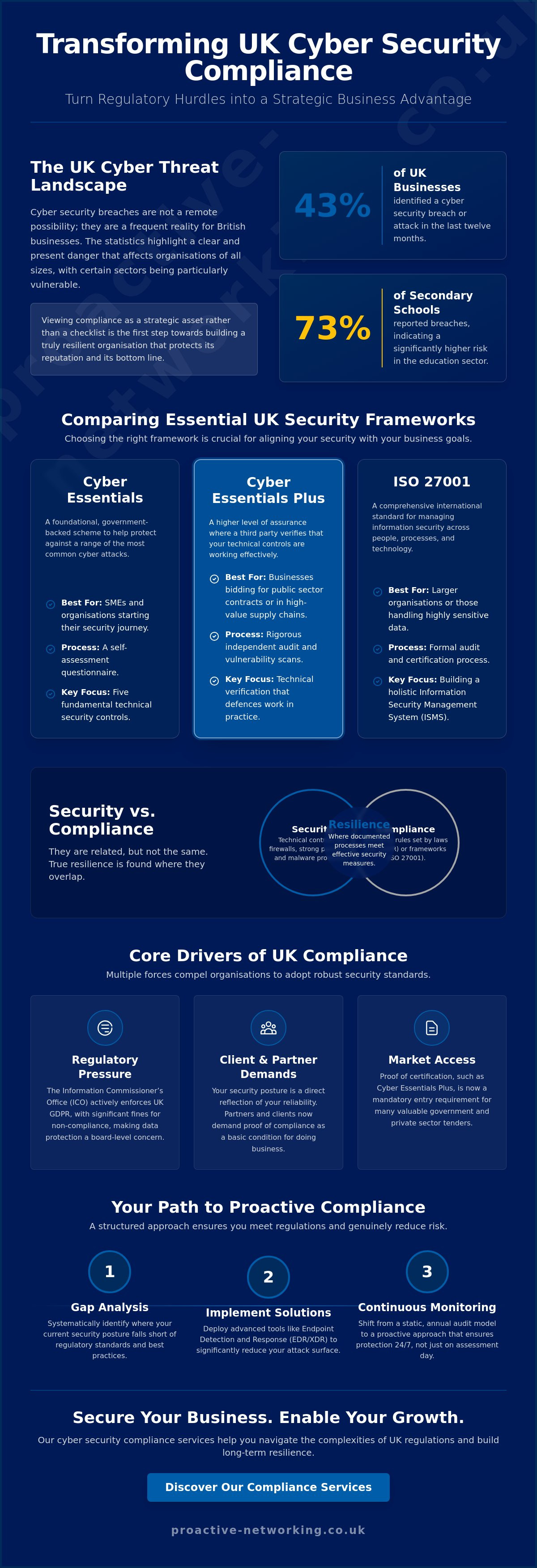
We understand that the landscape feels increasingly complex, especially with secondary schools seeing breach rates rise to 73% and the financial sector preparing for new unified frameworks. However, viewing cyber security compliance services UK as a strategic asset rather than a mere checklist allows you to transform vulnerability into a competitive advantage. This guide explains how to navigate these regulations whilst building a truly resilient organisation that protects its reputation and its bottom line.
We will examine the latest 2026 standards, clarify the differences between essential certifications, and show you how to maintain a continuous, proactive security posture that satisfies both regulators and your most demanding clients.
Key Takeaways
Learn how professional cyber security compliance services UK can transform mandatory regulations into a strategic framework for business growth.
Distinguish between the foundational protections of Cyber Essentials and the comprehensive international standards of ISO 27001 to find the best fit for your operations.
Identify the specific regulatory expectations for the legal and financial sectors, including the latest DORA requirements and SRA standards.
Discover how a structured gap analysis and the deployment of EDR or XDR solutions can significantly reduce your organisation's attack surface.
Understand the critical steps for maintaining GDPR compliance and data integrity during complex company mergers or separations.
Table of Contents
What are Cyber Security Compliance Services in the UK?
Cyber security compliance services UK provide the essential framework needed to align an organisation’s technical infrastructure with national legal requirements and industry standards. This process involves more than just installing software; it's a comprehensive strategy to ensure that data handling and protection methods satisfy the rigorous expectations of UK law. The National Cyber Security Centre (NCSC) plays a pivotal role here, setting the benchmarks that define what good security looks like for British businesses. By 2026, we have seen a definitive move away from the static, annual audit model towards continuous compliance monitoring. This proactive approach ensures that your business remains protected every hour of the day, rather than just on the day an assessor visits.
Securing a position on government or private sector tenders now almost universally requires proof of robust cyber hygiene. For many ambitious SMEs, professional cyber security compliance services UK are no longer a "nice to have" feature; they are a mandatory entry requirement for high-value contracts. Without a recognised accreditation, your organisation may be excluded from lucrative supply chains before you've even had the chance to pitch your services. This shift reflects a broader market trend where security is viewed as a foundational element of corporate responsibility.
The Distinction Between Security and Compliance
It's a common misconception that being secure is the same as being compliant. You may have implemented strong passwords and firewalls, but if your processes aren't documented or if you lack a formal incident response plan, you remain non-compliant with frameworks like ISO 27001. Compliance frameworks provide a clear roadmap that guides your technical investments, ensuring they deliver the maximum possible protection for your specific risks. A significant hurdle for modern firms is the rise of shadow IT amongst remote workers. When staff use unauthorised applications to share sensitive data, they create invisible vulnerabilities that undermine your regulatory standing and complicate the audit process.
Core Drivers of UK Compliance
The Information Commissioner’s Office (ICO) continues to enforce the UK GDPR with precision, making the financial and reputational risks of a breach impossible to ignore. However, the pressure often comes from closer to home. Your clients and partners now view your security posture as a reflection of your reliability. They require assurance that their data is safe in your hands, often demanding adherence to the Cyber Essentials scheme as a baseline for doing business. Ultimately, strategic compliance serves as a business enabler that builds long-term resilience and professional credibility rather than being a bureaucratic hurdle.
Comparing the Essential UK Security Frameworks
Selecting the correct framework depends entirely on your organisation’s size and the sensitivity of the data you manage. Whilst GDPR provides the mandatory legal floor for protecting personal information, it doesn't offer a specific technical blueprint for daily operations. This is where frameworks like Cyber Essentials and ISO 27001 become invaluable. For many UK firms, the NCSC's Small Business Guide serves as a foundational resource for understanding these expectations before committing to a formal certification path.
Professional cyber security compliance services UK help you bridge the gap between these different standards by identifying which controls offer the most immediate value. Cyber Essentials is often the first step for SMEs. It focuses on five fundamental technical controls: firewalls, secure configuration, user access control, malware protection and security update management. By achieving this, you demonstrate to potential clients that you've mitigated the most common internet based threats that exploit lack of basic hygiene.
Cyber Essentials and Cyber Essentials Plus
The standard Cyber Essentials is a self assessment process, but Cyber Essentials Plus involves a more rigorous independent audit. This includes a technical verification where an assessor conducts vulnerability scans to ensure your defences work in practice. This higher level of assurance is frequently required for government contracts and high value supply chains. If you're deciding between these and more complex standards, you can read our detailed breakdown of Cyber Essentials vs ISO 27001 to determine the best fit for your current growth stage.
ISO 27001: Building an Information Security Management System
While Cyber Essentials focuses on specific technical settings, ISO 27001 is centred on an Information Security Management System (ISMS). This international standard requires a holistic approach to risk management involving people, processes and technology. It's particularly suited for high growth SMEs or those handling sensitive client information in the legal or financial sectors where trust is a primary currency. The benefit of ISO 27001 is its focus on continuous improvement through the "Plan-Do-Check-Act" cycle. It doesn't just ask if you're secure today; it builds a culture where security evolves alongside your business. This scalability is vital for firms looking to expand or secure enterprise level contracts. Effective cyber security compliance services UK ensure your ISMS remains robust without becoming a burden on your internal resources.
If you're unsure which framework aligns with your commercial objectives, Proactive Networking Ltd can help you align your security strategy with your long term business goals.
Sector Specific Compliance: Legal, Finance and Education
Generic frameworks provide a solid foundation, but they often lack the granular detail required by highly regulated industries. For organisations in the legal, financial, and education sectors, professional cyber security compliance services UK must be tailored to address specific statutory obligations and professional codes of conduct. These sectors face unique threat profiles, ranging from targeted phishing of solicitors to large scale ransomware attacks on educational institutions. Navigating these requirements demands a sophisticated understanding of how technical controls map to specific regulatory outcomes.
The complexity of these niche regulations means that a "tick-box" approach is rarely sufficient. Instead, firms require bespoke consultancy that integrates security into the fabric of their specific workflows. This ensures that compliance doesn't hinder productivity but rather provides a stable platform for secure, efficient operations.
Cyber Security for Solicitors and Barristers
Legal professionals operate under a strict duty of confidentiality, where a data breach can result in professional misconduct proceedings from the SRA or the Bar Council. Protecting legal privilege requires more than just standard encryption; it necessitates advanced email and sign-in protection to ensure that only authorised personnel can access sensitive case files. Law firms and Chambers handling high value transactions are particularly vulnerable to 'Friday afternoon' wire fraud, where attackers intercept communications to redirect client funds. By implementing rigorous compliance controls, firms can verify the integrity of every transaction and communication. You can explore our specialist IT support for solicitors to see how these protections are integrated into daily legal workflows.
Finance and Education Requirements
In the financial sector, the focus has shifted towards operational resilience. Navigating FCA regulations now includes meeting the stringent demands of the Digital Operational Resilience Act (DORA), which requires firms to demonstrate their ability to withstand, respond to, and recover from ICT related disruptions. This goes beyond simple backups, requiring comprehensive business continuity and disaster recovery planning that aligns with the UK Government Cyber Security Standard for critical infrastructure assets.
Educational institutions face a different set of challenges. Schools and colleges must protect student data whilst managing a vast attack surface created by hundreds of staff and student users. Meeting Department for Education (DfE) standards involves securing EdTech platforms and ensuring that multi-user environments don't become entry points for malicious actors. Whether you're managing a law firm or a multi-academy trust, utilising expert cyber security compliance services UK ensures that your organisation meets its specific legal obligations whilst maintaining seamless operations.
The Path to Compliance: Implementation and Attack Surface Reduction
Achieving a robust regulatory posture is not a static destination. It is a continuous cycle of assessment and refinement. Professional cyber security compliance services UK provide the structured methodology required to move your organisation from its current state to a position of verified resilience. This journey begins with a clinical gap analysis. This initial phase identifies exactly where your existing controls fall short of standards like Cyber Essentials or ISO 27001, allowing for a prioritised investment strategy that addresses the most critical vulnerabilities first.
The implementation phase follows a logical sequence to ensure total coverage:
Step 1: Gap Analysis. A thorough review of your technical infrastructure, policies, and procedures against your chosen framework.
Step 2: Technical Remediation. Deploying advanced controls such as EDR and XDR solutions to close identified security holes.
Step 3: Staff Awareness. Organising comprehensive training programmes to mitigate the human risk factor, which remains the primary entry point for phishing.
Step 4: Formal Audit. Undergoing a rigorous assessment by an accredited body to achieve your formal certification.
Step 5: Continuous Monitoring. Establishing real-time oversight to ensure that your compliance status does not lapse as your business evolves.
Why Attack Surface Reduction is Critical for Compliance
Your attack surface consists of every possible entry point a malicious actor could exploit, including public facing IP addresses, employee mobile devices, and unpatched software. Identifying and minimising these points is a fundamental requirement for modern compliance. By decommissioning legacy systems and tightening access controls, you simplify the audit process and reduce the volume of data that needs to be monitored. A smaller attack surface directly correlates to a lower risk of GDPR breaches. This proactive reduction ensures that your security team can focus their resources on protecting your most valuable assets rather than defending unnecessary digital territory.
Leveraging EDR and XDR for Continuous Compliance
Modern standards like ISO 27001 place heavy emphasis on the ability to detect and respond to threats in real time. Endpoint Detection and Response (EDR) provides the granular visibility needed to satisfy these monitoring requirements at the device level. For SMEs seeking a more comprehensive shield, Extended Detection and Response (XDR) integrates data across your entire network, including email and cloud environments. This provides the sophisticated, multi-layered cyber security for SMEs that is now expected by UK regulators and enterprise partners alike.
If you are ready to secure your operations against evolving threats, our team can conduct a comprehensive gap analysis to kickstart your journey toward certified compliance. Utilising professional cyber security compliance services UK ensures that your technical controls are not just present, but are effectively protecting your commercial interests.
Maintaining Compliance During Business Mergers and Separations
Structural changes like mergers or divestitures present some of the most significant risks to an organisation’s regulatory standing. When two entities combine their digital assets, they don't just merge talent and revenue; they merge vulnerabilities. Professional cyber security compliance services UK are essential during these transitions to ensure that sensitive data remains protected and that legal obligations aren't compromised in the rush to integrate systems. A lack of strategic oversight during a merger can lead to invisible gaps in your security posture that only become apparent after a breach has occurred.
Proactive Networking Ltd acts as a protective guardian during these complex transitions, providing the technical expertise needed to manage data integrity. We ensure that your compliance framework remains a stable foundation, regardless of how your corporate structure evolves. By treating IT integration as a core part of your merger strategy, you protect your reputation and ensure a seamless transition for your staff and clients alike.
Due Diligence in IT Mergers
Conducting thorough due diligence before a merger is finalised is a critical step in protecting your existing infrastructure. You must assess the security posture of the acquired company to identify any legacy weaknesses or existing compliance failures. Failing to do so risks "inheriting" a security incident that could lead to severe ICO penalties under the UK GDPR. Standardising security controls across the newly formed organisation ensures that every user and device meets your established benchmarks for safety. This methodical approach allows you to consolidate systems without introducing unnecessary risk into your environment.
Secure Data Separations
Separating corporate data during a business split is technically complex and carries high stakes for data privacy. You have to ensure that sign-in protection and user data are cleanly decoupled without disrupting business continuity. This process requires a structured approach to re-organising IT infrastructure whilst maintaining the integrity of shared databases. For firms undergoing such transitions, seeking managed IT support for small business UK provides the expertise needed to manage these shifts securely. It's about ensuring that the departing entity no longer has access to sensitive resources whilst the remaining organisation maintains its regulatory adherence.
During these periods of flux, brand reputation is often at its most vulnerable. Managed domain hosting, supported by DMARC, SPF and DKIM protocols, ensures that your communications remain authenticated and secure. Proactive Networking Ltd serves as a calm, steady partner, providing the strategic foresight required to manage company data mergers and separations without compromising your regulatory status. By delegating these technical complexities to a seasoned expert, you ensure that your transition is marked by stability rather than security lapses. Our cyber security compliance services UK are designed to adapt to your business needs, providing comprehensive protection through every stage of your corporate journey.
Future Proof Your Business with Strategic Resilience
Navigating the UK’s regulatory landscape in 2026 requires a shift from reactive fixes to a culture of continuous vigilance. We have explored how frameworks like Cyber Essentials and ISO 27001 provide more than just a badge of honour; they offer a structured roadmap to protect your most sensitive data. Whether you're managing the strict confidentiality requirements of a law firm or overseeing complex data mergers, maintaining a robust security posture is vital for long term growth. Utilising professional cyber security compliance services UK ensures that your organisation remains both compliant and competitive in an increasingly digital marketplace.
Proactive Networking Ltd brings over 25 years of experience in SME IT support to every partnership. We specialise in the unique compliance demands of the legal and financial sectors, integrating comprehensive EDR and XDR security to provide real time protection. Our team acts as a steady guardian for your operations, simplifying technical complexities so you can focus on your core objectives. Secure your business with expert compliance consultancy from Proactive Networking Ltd and build the resilient foundation your organisation deserves. Your journey toward total security starts with a single, strategic step.
Frequently Asked Questions
Is cyber security compliance mandatory for small businesses in the UK?
While some frameworks are voluntary, adherence to the UK GDPR is a legal requirement for any organisation processing personal data. Furthermore, many government and private sector contracts now mandate Cyber Essentials certification as a prerequisite for bidding. Even when not legally required, maintaining a recognised standard is essential for managing professional liability and meeting the expectations of your insurers.
How much do cyber security compliance services typically cost for an SME?
The total investment for cyber security compliance services UK varies depending on the size of your organisation and the complexity of your existing infrastructure. Official IASME assessment fees for Cyber Essentials start at £300 + VAT for micro-businesses, but this does not include the professional consultancy or technical remediation required to meet the standards. A tailored approach ensures you only invest in the specific controls and monitoring your business actually needs.
What is the difference between Cyber Essentials and Cyber Essentials Plus?
Cyber Essentials is a self assessment process where you verify your own technical controls, whereas Cyber Essentials Plus involves a rigorous independent audit. During a Plus assessment, a qualified professional performs a hands-on technical verification and vulnerability scan of your systems. This higher level of assurance is often required for organisations working within sensitive supply chains or handling high value government data.
Can GDPR compliance be fully automated with software?
No, GDPR compliance cannot be achieved through software alone as it requires a combination of technical controls, documented policies, and staff behaviour. Whilst automation tools are excellent for data mapping and breach detection, they cannot replace the strategic oversight and human decision making needed to manage data privacy. Compliance is a continuous management process rather than a simple technical "set and forget" solution.
How long does it take to achieve ISO 27001 certification?
Most SMEs should expect the process to take between six and twelve months from the initial gap analysis to the final audit. The timeline depends heavily on the maturity of your current Information Security Management System (ISMS) and the resources you can dedicate to implementation. A structured approach ensures that you build a sustainable framework that grows with your organisation rather than rushing a temporary fix.
What happens if my business fails a compliance audit?
Failing an audit is not a permanent setback but a vital opportunity to identify and rectify hidden vulnerabilities before they are exploited. Your assessor will provide a detailed report outlining any non-conformities or areas for improvement. You can then work with your technical partner to implement the necessary remediation before applying for a re-assessment to secure your certification.
Do I need a dedicated Data Protection Officer (DPO) for GDPR?
You only need to appoint a formal DPO if you are a public authority or if your core activities involve large scale systematic monitoring or processing of sensitive personal data. Many small businesses choose to outsource this expertise to professional cyber security compliance services UK providers. This allows you to access high level guidance and ensure your data protection obligations are met without the cost of a full time executive hire.
How often should a business re-certify for Cyber Essentials?
Re-certification for Cyber Essentials must take place every twelve months to ensure your defences remain effective against the latest digital threats. This annual review allows you to verify that your technical controls are still functioning correctly and that any new hardware or software has been integrated securely. Regular re-certification demonstrates a persistent commitment to security that builds long term trust with your clients and partners.


Comments