


EDR and XDR Security Solutions: A Comparison for UK SMEs in 2026
- Simon Raine
- Jun 13
- 12 min read
Recent data indicates that 43% of UK businesses experienced a cyber security breach or attack in the last 12 months. When evaluating edr and xdr security solutions, many SME leaders find that this figure reflects a genuine concern regarding the safety of their digital assets and the continuity of their operations. You may find yourself feeling overwhelmed by complex industry jargon or anxious about the threat of sophisticated ransomware attacks, especially when internal resources to monitor alerts around the clock are limited.
We recognise that you require a strategy that provides both peace of mind and a clear return on investment. Understanding the distinction between these technologies is essential for establishing a robust defence that works effectively whilst your team is offline. This article provides a comprehensive comparison of these solutions, helping you to determine the most effective approach for your infrastructure. We will examine how these tools support compliance with standards such as ISO 27001 and Cyber Essentials, ensuring your business remains resilient and secure in an increasingly complex digital environment.
Key Takeaways
Understand why traditional antivirus is no longer sufficient and how EDR provides the necessary foundation for modern endpoint protection.
Learn how to differentiate between edr and xdr security solutions to identify which level of visibility best suits your specific digital attack surface.
Discover how XDR correlates data across networks and cloud environments to reduce alert fatigue, ensuring your team isn't overwhelmed by technical noise.
Identify how advanced security monitoring supports your journey towards ISO 27001 compliance and meets the evolving requirements of the Cyber Security and Resilience Bill.
Recognise why expert management is the critical component that transforms sophisticated software into a dependable shield for your business operations.
Table of Contents
Understanding EDR and XDR Security Solutions in 2026
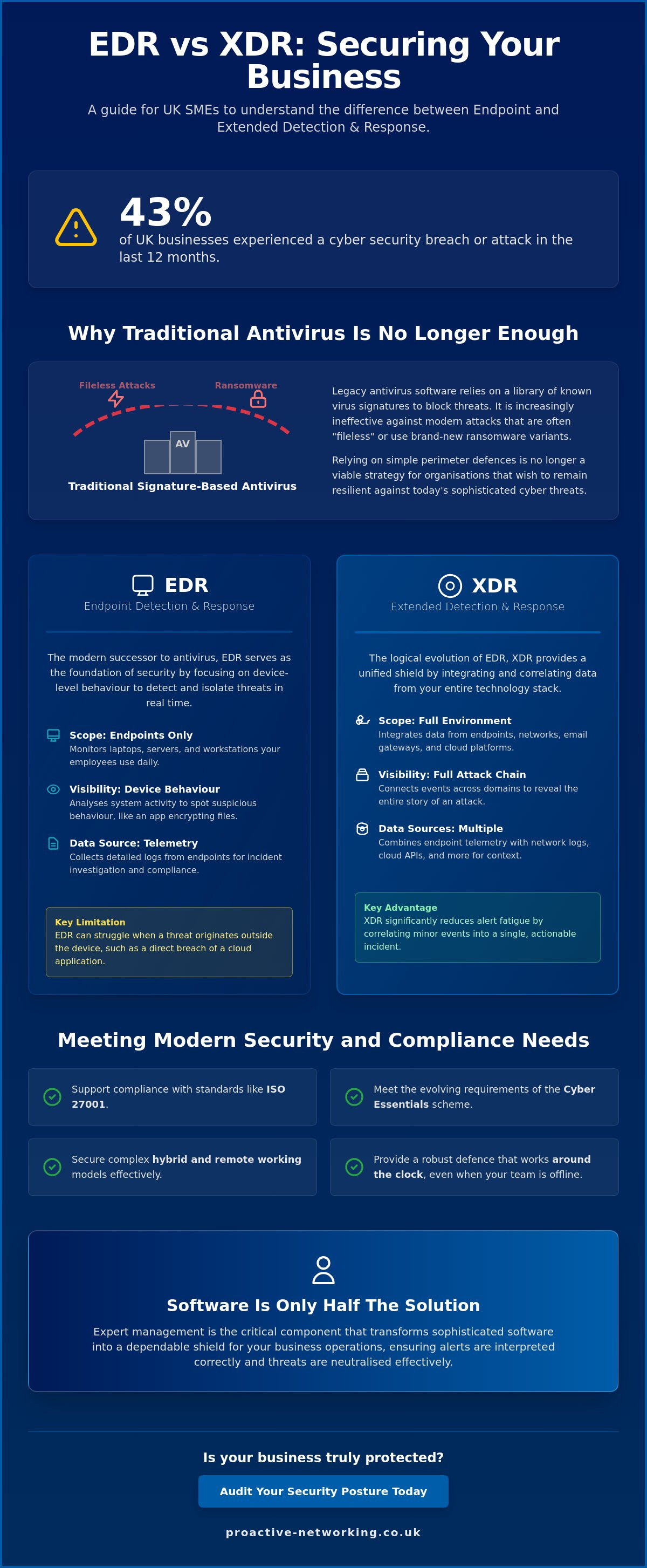
The digital boundaries of the average UK business have dissolved. Where we once relied on a simple firewall to protect a central office, we now manage a fragmented network of remote laptops, cloud applications and mobile devices. Traditional antivirus software, which relies on a library of known signatures to block threats, is increasingly ineffective against modern, fileless attacks. This shift has necessitated a move towards more sophisticated edr and xdr security solutions that prioritise visibility and behaviour over simple blocking. Relying on perimeter-based defences alone is no longer a viable strategy for organisations that wish to remain resilient against the sophisticated ransomware tactics seen in 2026.
The Role of EDR in Modern Defence
Endpoint Detection and Response (EDR) serves as the modern successor to legacy antivirus. It focuses specifically on the endpoints, which include the laptops, servers and workstations that your employees use daily. Rather than just waiting for a known virus to appear, EDR monitors the behaviour of these devices in real time. If a legitimate application suddenly begins encrypting files or attempting to communicate with an unknown external server, the system flags this as suspicious behaviour. This allows for an immediate response, often isolating the affected machine before a breach can spread.
One of the primary benefits of EDR is the collection of telemetry. This detailed log of system activity allows security teams to conduct thorough incident post-mortems. By reviewing exactly how a threat entered the network and what actions it took, businesses can strengthen their defences for the future. It's a proactive approach that moves beyond reactive security, providing the evidence needed to satisfy compliance audits and insurance requirements.
The Emergence of XDR
While EDR provides excellent visibility at the device level, Extended Detection and Response (XDR) represents the next logical evolution in cyber security. It breaks down the traditional silos between different security tools by integrating data from your network, email gateways and cloud environments. This holistic perspective is crucial because attackers rarely target a single device in isolation. They often start with a phishing email, move through the network and eventually target sensitive data stored in Microsoft 365 or other cloud platforms.
By correlating events across these different domains, edr and xdr security solutions provide a clearer picture of the entire attack chain. This reduces alert fatigue for your team, as the system can identify that several seemingly minor events are actually parts of one coordinated breach. For organisations operating hybrid work models or those subject to the Cyber Security and Resilience Bill, XDR is fast becoming the standard for maintaining a dependable and compliant security posture. It ensures that security isn't just a series of isolated checkpoints but a unified, intelligent shield protecting every facet of your operation.
EDR: The Foundation of Endpoint Security
Endpoint Detection and Response (EDR) represents the fundamental layer of a modern security stack. It provides continuous monitoring and data collection from every connected company device, ensuring that no activity goes unrecorded. This constant stream of telemetry allows for automated response capabilities; for instance, if a server exhibits signs of a ransomware infection, the system can immediately isolate that machine from the wider network. This prevents lateral movement, effectively containing the threat before it can compromise your entire business infrastructure. Whilst EDR is incredibly powerful, it's often most effective when integrated into broader advanced threat detection services that provide the human oversight necessary to interpret complex alerts.
However, EDR has its boundaries. It's designed to protect the device itself, but it can struggle when a threat originates elsewhere, such as a cloud-to-cloud attack or a direct breach of a SaaS application. In these scenarios, the device might remain clean whilst your data is being exfiltrated from a cloud storage bucket. This is where the broader context of edr and xdr security solutions becomes relevant, as businesses must decide if they need visibility beyond the physical hardware. If you're unsure if your current setup meets these standards, our team can help you audit your endpoint security to identify any potential gaps.
Key Capabilities of EDR Systems
EDR offers real-time visibility into process executions and registry changes, allowing administrators to see exactly what is happening under the bonnet of any workstation. This level of detail is invaluable for 'threat hunting' across the estate, enabling your team to search historical data for indicators of compromise that may have been missed initially. By integrating these tools with existing IT support workflows, remediation becomes rapid and methodical, reducing the time a business remains vulnerable after a discovery.
Why EDR is Essential for Cyber Essentials
For UK SMEs, EDR is a critical tool for meeting the rigorous requirements of Cyber Essentials and Cyber Essentials Plus. It aids in malware protection and ensures that patch management is being followed across all devices. The detailed audit logs generated by EDR provide the necessary evidence for insurance providers and compliance bodies, proving that your organisation takes a proactive stance on security. This aligns with the objectives outlined in the UK Government's Cyber Security Strategy, which emphasises the need for resilient digital foundations. Ultimately, EDR acts as the 'black box flight recorder' for every business computer, capturing every detail so that nothing is left to guesswork.
XDR vs EDR: A Practical Comparison for SMEs
Choosing between edr and xdr security solutions isn't merely a technical decision; it's a strategic choice that defines how your business manages risk. Whilst EDR provides deep visibility into individual devices, it often operates in a vacuum. XDR, by contrast, gathers cross-domain telemetry from your entire environment. This includes your email server, your identity provider, and your cloud storage. Leading tech publications are increasingly explaining EDR and XDR as the difference between a security guard watching one door and a centralised command centre monitoring every entrance, corridor, and safe.
For a UK SME, the most tangible benefit of XDR is the reduction in alert fatigue. Small IT teams don't have the capacity to investigate hundreds of disconnected notifications every day. XDR correlates these events automatically. It recognises that a suspicious login from an unusual location, followed by an unusual file download on a laptop, are part of the same incident. This correlation improves detection accuracy and allows for unified orchestration. You can revoke a user's access across the entire network and isolate their device with a single click, significantly increasing your response speed. This level of control is vital for maintaining stability in a fast-moving threat landscape.
The Visibility Gap
A significant risk for modern businesses is the blind spot created by fileless attacks. EDR is excellent at catching malware, but it often misses phishing attempts that lead to credential theft without ever dropping a file on the machine. If an attacker gains access to your Microsoft 365 environment through a stolen password, an endpoint-only solution might see nothing wrong. XDR tracks that stolen credential from the initial sign-in through to data exfiltration. This comprehensive approach is a cornerstone of multi-layered cyber security for smes, ensuring that your defence adapts to the way employees actually work in 2026. It bridges the gap between the device and the cloud identity.
Operational Efficiency for Small Teams
Managing disparate security tools is a time-consuming burden that many SMEs simply cannot afford. XDR simplifies this by consolidating your security posture into a single dashboard. Instead of jumping between different consoles to check email logs and then server logs, your team sees a unified timeline of activity. This automation handles the repetitive, lower-level tasks, allowing your internal staff to focus on higher-level strategy and business growth. Whilst XDR carries a higher premium than standalone EDR, the investment is often justified by the lower risk of a total breach. The cost of a single day of downtime far outweighs the monthly subscription for a superior, proactive defence.
Choosing the Right Solution for Your Business Requirements
Selecting between edr and xdr security solutions requires a methodical assessment of your digital footprint. It's a common misconception that smaller businesses should automatically opt for EDR whilst larger ones require XDR. In reality, the decision is dictated by the complexity of your infrastructure and the sensitivity of the data you manage. If your team relies heavily on SaaS applications, cloud servers, and a distributed workforce of remote workers, your attack surface is significantly broader than a business operating from a single physical office. You must also evaluate whether your team has the internal skill to manage the sophisticated alerts these systems generate, as a tool is only as effective as the person prioritising its data.
Regulatory obligations also play a decisive role in this choice. For UK SMEs aiming for ISO 27001 or those handling sensitive personal data under GDPR, the level of continuous monitoring required often points towards a more integrated approach. You must also consider the role of anti-phishing protection for businesses. Since phishing remains the most prevalent attack vector, experienced by 38% of UK businesses according to 2026 data, your chosen solution must be able to track threats that start in an inbox before they ever touch an endpoint.
Before committing to a specific technology, consider your internal resource availability. XDR provides a wealth of data, but it requires a level of expertise to investigate correlated alerts and respond effectively. If your IT team is already stretched thin, the increased visibility could lead to alert fatigue rather than improved security. In such cases, the focus should be on how the technology integrates with your wider support strategy to ensure that alerts are acted upon whilst your team remains focused on core business tasks.
When EDR is the Correct Choice
EDR is often the most appropriate starting point for businesses with relatively simple IT estates and centralised on-premise data storage. If your primary goal is to move beyond basic antivirus and achieve Cyber Essentials certification, EDR provides the necessary device-level visibility without the complexity of cross-domain integration. It's a dependable choice for budget-conscious firms that need robust protection for their physical workstations and servers but haven't yet moved their entire operation to the cloud.
When XDR is Non-Negotiable
For organisations operating in highly regulated sectors such as law, finance, or barristers' chambers, XDR is frequently non-negotiable. These firms often follow a 'cloud-first' strategy, utilising Microsoft 365 and various third-party SaaS platforms to manage sensitive client files. In these environments, an endpoint-only view is insufficient. XDR becomes essential if your business cannot afford more than an hour of downtime or if a data breach would result in severe regulatory penalties. If you're ready to secure your infrastructure against these risks, you can explore our cyber security services to find the right fit for your specific compliance needs.
Managed EDR and XDR: The Proactive Networking Approach
Implementing edr and xdr security solutions is a significant step toward resilience, but the software is rarely a 'silver bullet' on its own. Sophisticated tools require equally sophisticated oversight to be effective. At Proactive Networking Ltd, we integrate these technologies into a comprehensive IT support strategy that prioritises stability and clear communication. With 25 years of experience supporting UK SMEs, particularly in the legal and finance sectors, we've seen that the most successful security postures aren't built on software alone. They're built on the mastery of that software by seasoned professionals who understand the nuances of compliance and business continuity. We move beyond complex technical jargon to provide your leadership team with clear, actionable insights that protect your commercial interests.
Expert Monitoring and Maintenance
Our team acts as a protective guardian for your digital operations, ensuring that your chosen edr and xdr security solutions are not just installed, but correctly configured and continuously updated. It's common for automated tools to generate high volumes of data that can be difficult to interpret without context. We provide the human intelligence necessary to distinguish between a routine system update and a genuine indicator of compromise. This proactive involvement ensures that your IT maintenance and monitoring are handled with a high degree of confidence. By taking this responsibility off your internal staff, we allow them to focus on business growth whilst we maintain a quiet, steady watch over your infrastructure.
Securing Your Future with Proactive Networking
Cyber security is not a one off project; it's an evolving roadmap that must grow alongside your business requirements. We specialise in creating unified defences that integrate email, user, and sign in protection with your endpoint or extended detection systems. This structured approach ensures that as your team adopts new cloud services or expands into new markets, your security remains a dependable foundation rather than a bottleneck. Whether you are aiming for ISO 27001 compliance or simply want the peace of mind that your business is protected whilst your team is offline, we provide the strategic foresight needed to stay ahead of emerging threats. Take the first step toward a more resilient future by contacting us to arrange a security audit today.
Securing Your Digital Resilience in an Evolving Threat Landscape
Mastering the complexities of modern cyber security requires a strategic shift from simple blocking to comprehensive visibility. This comparison has shown how EDR provides a vital foundation for device level safety, whilst XDR offers the cross domain telemetry necessary for organisations with hybrid cloud environments. Choosing between edr and xdr security solutions ultimately depends on your specific attack surface and the regulatory standards you must uphold, such as ISO 27001 or Cyber Essentials. As threats become more sophisticated, the focus must remain on proactive detection and rapid response rather than just reactive tools.
With over 25 years of UK SME IT expertise, our team at Proactive Networking specialises in comprehensive attack surface reduction strategies that protect your commercial interests. We ensure your defences are managed by experts who understand the nuances of compliance in the legal and finance sectors. Secure your business with expert led EDR and XDR solutions from Proactive Networking and gain the confidence that your operations are being guarded by a dependable partner. Your journey toward a more resilient future starts with a clear, well managed strategy that works whilst your team focuses on growth.
Frequently Asked Questions
Is EDR better than traditional antivirus for my small business?
EDR is significantly more effective than traditional antivirus because it focuses on behaviour rather than just matching known file signatures. Whilst legacy antivirus waits for a known threat to appear, EDR monitors system activity in real time to identify suspicious patterns. This proactive approach allows it to catch modern, fileless attacks that traditional tools would ignore, providing a much higher standard of protection for your company's endpoints.
Can XDR replace all my other security tools?
XDR is not intended to replace every security tool in your estate, but rather to integrate and unify them. It acts as a central orchestration layer that correlates data from your network, email, and cloud environments. While it may consolidate some standalone monitoring tools, you will still require fundamental defences such as firewalls, local and cloud data backup, and robust email filtering to maintain a resilient infrastructure.
How does XDR help with GDPR compliance in the UK?
XDR enhances GDPR compliance by providing the comprehensive visibility needed to detect and report data breaches within the required 72-hour window. By tracking a threat from its initial entry point through to any attempted data exfiltration, it creates a detailed audit trail. This level of forensic evidence is essential for proving to regulators that you have implemented appropriate technical and organisational measures to protect personal data.
Do I need a dedicated security team to run an XDR solution?
Running an XDR solution effectively usually requires specialised expertise to interpret the correlated data and respond to complex alerts. For many UK SMEs, maintaining a dedicated internal security team is often cost prohibitive. This is why many organisations choose a managed approach, where a partner handles the monitoring and maintenance, ensuring that your edr and xdr security solutions are fully optimised without burdening your existing IT staff.
What is the typical implementation time for an EDR system?
The typical implementation time for an EDR system ranges from a few days to several weeks, depending on the number of endpoints and the complexity of your network. The initial deployment involves installing lightweight agents on all devices and configuring policies to match your specific operational needs. Once active, the system requires a short 'learning' period to establish a baseline of normal behaviour for your environment.
Can EDR and XDR prevent zero-day ransomware attacks?
While no tool can guarantee 100% prevention, edr and xdr security solutions are specifically designed to detect the behaviours associated with zero-day ransomware. By identifying unusual activities, such as sudden mass file encryption or unauthorised registry changes, these systems can automatically isolate affected machines. This rapid response contains the threat immediately, preventing a single infection from escalating into a full scale business continuity crisis.
How does XDR integrate with Microsoft 365 licensing?
XDR integration often relies on the advanced telemetry provided by specific Microsoft 365 licensing levels, such as Business Premium or Enterprise E5. These tiers include built-in security features that feed data directly into an XDR platform. By leveraging your existing Microsoft ecosystem, you can create a unified defence that monitors email, user logins, and cloud applications without the need for multiple disconnected third-party agents.
Is XDR worth the extra cost for a company with fewer than 50 staff?
The value of XDR is determined by the sensitivity of your data and your regulatory requirements rather than headcount alone. For a company with fewer than 50 staff in the legal or finance sectors, the risk of a breach often justifies the investment. XDR provides the comprehensive protection and audit logs necessary for high-tier compliance, ensuring that your business remains a dependable partner for larger organisations in your supply chain.


Comments