


Managed Email Security Services: A Strategic Guide for UK SMEs in 2026
- Simon Raine
- Jun 2
- 12 min read
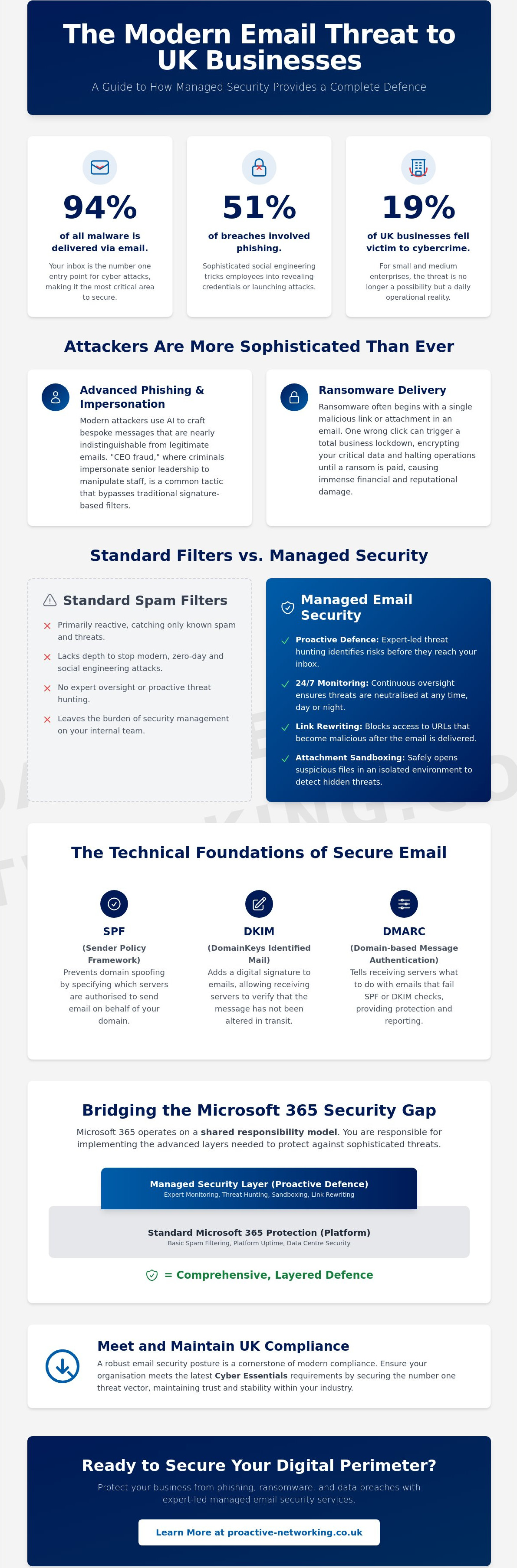
Did you know that 94% of all malware is delivered directly to your staff through their inboxes? For UK small and medium enterprises, the threat is no longer a distant possibility but a daily reality. 19% of UK businesses fell victim to cybercrime in the last year, with phishing accounting for over half of those incidents. It's natural to feel a sense of anxiety regarding potential data breaches or to find the technical complexities of SPF and DMARC settings increasingly overwhelming, particularly as the NCSC retires its Mail Check service in March 2026.
We understand that you require more than just a simple filter; you need a dependable partner to secure your digital perimeter. This guide explains how managed email security services protect your operations from sophisticated phishing and ransomware whilst ensuring your organisation remains compliant with the latest Cyber Essentials standards. You'll gain a clear understanding of the necessary layers of email protection and discover how to eliminate the risk of human error. We'll outline a strategic approach that provides lasting peace of mind and keeps your business resilient against the evolving threats of 2026.
Key Takeaways
Recognise why email remains the primary vector for 94% of malware and how sophisticated phishing attempts bypass standard security protocols.
Understand the distinction between basic spam filters and comprehensive managed email security services that offer proactive threat hunting and expert intervention.
Identify the security gaps within the Microsoft 365 shared responsibility model and learn how to implement the additional layers required for high-risk sectors.
Gain clarity on essential technical foundations like SPF, DKIM and DMARC to prevent domain spoofing and ensure your critical business communications reach their destination.
Ensure your organisation meets the latest 2026 UK compliance requirements, including Cyber Essentials, to maintain trust and stability within your industry.
Table of Contents
Understanding the Modern Email Threat Landscape for UK Businesses
What are Managed Email Security Services? (Beyond Simple Spam Filters)
The Gap in Standard Protection: Why Microsoft 365 Alone Often Falls Short
The Technical Foundations of Secure Email: SPF, DKIM and DMARC
Choosing a Managed Partner: How Proactive Networking Secures Your Communications
Understanding the Modern Email Threat Landscape for UK Businesses
Managed email security services represent more than just a software installation; they function as a sophisticated, expert-led defence layer designed to protect the integrity of your business communications. While many small firms rely on basic, reactive filters, a managed approach provides the proactive threat hunting necessary to intercept risks before they reach a user's inbox. This is vital because email remains the primary entry point for cyber attacks. Statistics from the Cyber Security Breaches Survey 2026 indicate that phishing was experienced by 51% of breach victims, and it's widely recognised that 94% of all malware is delivered via email.
The transition from generic spam to highly targeted social engineering has changed the stakes for UK SMEs. A single breach in 2026 carries a heavy price, often resulting in severe financial loss and lasting reputational damage. For sectors such as legal and finance, where trust is a primary asset, the fallout from a compromised account can be catastrophic. Integrating these protections into a broader strategy for multi-layered cyber security for SMEs ensures that email is no longer your weakest link. This structured approach allows business owners to focus on growth rather than the anxiety of constant crisis management.
The Evolution of Phishing and Impersonation
Modern attackers now utilise advanced AI to craft perfectly phrased, bespoke messages that are nearly indistinguishable from legitimate correspondence. We see a significant rise in "CEO fraud," where criminals impersonate senior leadership to manipulate staff into diverting funds. Because these threats are often text-only, traditional signature-based filters won't catch them. A robust defence requires Email authentication protocols and behavioural analysis to identify these subtle anomalies and protect your staff from human error.
Ransomware: The Final Destination of Poor Email Hygiene
Ransomware often begins with a single malicious link that triggers a total business lockdown. Our managed email security services address this by using "sandbox" environments where suspicious attachments are opened safely in an isolated space. This proactive monitoring identifies hidden threats that standard antivirus software won't catch. By stopping attacks at the gateway, we provide the stability your organisation needs to operate without the constant fear of a digital shutdown, ensuring your data remains secure and accessible.
What are Managed Email Security Services? (Beyond Simple Spam Filters)
Many business owners mistake a standard spam filter for a complete security solution. In reality, managed email security services provide a sophisticated ecosystem that combines high-tier software with continuous human expertise. This approach shifts the burden from your internal team to seasoned professionals who specialise in Managed IT services for small businesses. Rather than waiting for a breach to occur, these services engage in active threat hunting to identify and neutralise vulnerabilities before they can be exploited. It's a fundamental shift from reactive defence to proactive guardianship.
Standard email providers offer basic filtering, but they often lack the depth required to stop modern, multi-stage attacks. Comprehensive managed email security services integrate Advanced Threat Protection to scrutinise every byte of data entering your network. One critical feature is link rewriting. This ensures that even if a URL is initially safe but later redirected to a malicious site, the system blocks access at the moment of the click. Similarly, attachment sandboxing allows suspicious files to be opened in a secure, isolated environment, protecting your local infrastructure from potential infection.
Maintaining this level of vigilance requires constant oversight. Cyber criminals operate across every time zone, so a global threat environment demands 24/7 monitoring. This ensures that a suspicious login attempt at 3:00 AM is identified and blocked immediately. For businesses looking to strengthen their overall posture, our team provides expert IT maintenance, support and monitoring to ensure your operations remain stable and secure.
Inbound vs Outbound Protection
While inbound security stops threats from reaching your staff, outbound protection is equally vital. It prevents your business domain from being hijacked to send spam or malware. If your domain is blacklisted due to poor outbound security, your legitimate invoices and client communications will fail to deliver. This causes significant operational friction and damages your professional reputation amongst your peers and clients.
Sign-in Protection and User Identity
Protecting the account is now as critical as protecting the message itself. Managed services integrate multi-factor authentication (MFA) and sign-in alerts to verify that every user is who they claim to be. We monitor for "impossible travel" scenarios, where a user appears to log in from London and then Singapore within the same hour. By securing the identity layer, we provide a robust barrier against account takeovers and unauthorised data access.
The Gap in Standard Protection: Why Microsoft 365 Alone Often Falls Short
Microsoft 365 serves as the operational backbone for the vast majority of UK SMEs, yet a common misconception persists regarding its inherent security. Many business owners assume that by adopting a cloud giant, their data is automatically shielded from every threat. In reality, Microsoft operates under a "shared responsibility" model. Whilst they secure the underlying physical infrastructure and platform availability, the responsibility for securing the data, identities and configurations within that environment rests solely with you. Relying on "out of the box" settings is a significant risk, particularly for those in high-stakes sectors like legal or finance where regulatory expectations are exceptionally high.
Standard security configurations are often designed for maximum compatibility rather than maximum protection. This often leaves backdoors open for sophisticated attackers who specialise in bypassing generic filters. To achieve true resilience, organisations require a "defence in depth" strategy. This involves layering managed email security services on top of your existing productivity suite. By doing so, you create multiple hurdles for an intruder to clear. We work closely with clients to optimise their Microsoft 365 Licensing, ensuring that security features are correctly enabled and aligned with the latest NCSC guidance on email security and anti-spoofing.
Configuration Mistakes in Small Businesses
Small teams often struggle with the complexity of security policies, leading to critical errors in setup. A frequent issue is "alert fatigue," where standard systems generate so many false positives that genuine threats are eventually ignored. Without the expert oversight provided by a managed partner, these subtle vulnerabilities go unnoticed. We provide the technical precision needed to tune your environment, ensuring that your IT maintenance, support and monitoring efforts are focused on real risks rather than background noise.
Supplementing with Advanced Threat Detection
While standard Exchange Online Protection (EOP) provides a baseline, it often lacks the agility of a managed XDR (Extended Detection and Response) solution. The value of managed email security services lies in human-led analysis. When a threat is ambiguous, a software-only approach might let it through or block a legitimate invoice. A dedicated security partner can verify these threats in real-time, offering a level of agility and accuracy that generic software providers simply cannot match. This proactive involvement ensures your business remains stable whilst navigating an increasingly hostile digital landscape.
The Technical Foundations of Secure Email: SPF, DKIM and DMARC
Identity is the cornerstone of modern digital trust. While we have discussed the external threats targeting your inbox, it's equally vital to ensure that your own outgoing communications are verified and trusted by the rest of the world. Without the correct technical foundations, your legitimate invoices or project updates could be flagged as spam or, worse, blocked entirely. This is where managed email security services provide essential value by configuring and maintaining the technical triad of SPF, DKIM and DMARC. These protocols prevent domain spoofing, a tactic where attackers impersonate your business to deceive your clients or suppliers.
Managing these records becomes increasingly complex as your organisation grows and adopts more cloud services. Every third party tool that sends email on your behalf, such as marketing platforms or accountancy software, requires precise configuration to avoid deliverability issues. This is not a task for a generalist. It requires a deep understanding of how DNS records interact with global mail servers. For a deeper dive into one of these pillars, you can refer to our DKIM security for business email guide.
SPF and DKIM: Your Digital Passports
Think of SPF (Sender Policy Framework) and DKIM (DomainKeys Identified Mail) as digital passports for your messages. SPF tells the receiving server exactly which IP addresses and services are authorised to send mail using your domain name. DKIM takes this a step further by adding a cryptographic signature to every message. This signature proves that the content hasn't been tampered with during transit. Together, these protocols ensure your emails are treated as authentic, significantly improving the chances of reaching a client's primary inbox rather than their junk folder.
DMARC: The Ultimate Domain Shield
DMARC (Domain-based Message Authentication, Reporting and Conformance) acts as the enforcement layer for the previous two protocols. It allows you to set a "Reject" policy, which instructs receiving servers to block any email that fails authentication checks. This prevents criminals from successfully spoofing your brand to commit fraud. Our managed email security services involve continuous monitoring of DMARC reports. We identify unauthorised attempts to use your domain and ensure your legitimate mail flow remains uninterrupted. This level of technical oversight provides the stability required for modern business operations.
If you are concerned about your current deliverability or domain reputation, our experts can help you implement Managed Domain Hosting including DMARC, SPF and DKIM security to safeguard your brand.
Choosing a Managed Partner: How Proactive Networking Secures Your Communications
Selecting a partner to oversee your digital communications is a decision that impacts your organisation’s long-term stability and reputation. With over 25 years of experience in securing UK small and medium-sized businesses, we understand that email protection cannot exist in a vacuum. Our managed email security services are designed to integrate seamlessly into a broader strategy for multi-layered cyber security for SMEs. This holistic approach ensures that your email defence is reinforced by robust network monitoring and identity management, creating a resilient environment that remains unfazed by technical challenges.
We specialise in providing security and compliance solutions for highly regulated sectors, including Legal, Finance and Education. For barristers, solicitors and financial advisors, the confidentiality of email correspondence is a non-negotiable requirement. Our team acts as a protective guardian, mastering the complexities of modern threats so you don't have to. By aligning your technical protocols with industry-specific standards, we ensure that your communications remain secure, professional and fully compliant with the expectations of your clients and regulatory bodies.
Compliance and Peace of Mind
In 2026, compliance is no longer a checkbox exercise but a fundamental requirement for business continuity. Our managed services are specifically tuned to help you meet the rigorous demands of ISO 27001 and the April 2026 Cyber Essentials updates. We ensure that mandatory multi-factor authentication (MFA) is correctly implemented across all cloud services and that critical security patches are applied within the required 14 day window. This level of diligence is essential for satisfying the supply chain security requirements of the Cyber Security and Resilience Bill, helping you win tenders and maintain trust amongst your partners.
Taking the Next Step with Proactive Networking
A professional audit is the first step toward a truly secure email environment. We're committed to simplifying complex technical landscapes, providing you with a clear roadmap for your security journey. Whether you require assistance with Cyber Essentials and GDPR Compliance or need to implement advanced sign-in protection, our experts are here to guide you. Contact us today to discuss a tailored plan for your managed email security services and discover the relief of having a seasoned expert managing your technical defences.
Building a Resilient Email Strategy for 2026 and Beyond
Protecting your business requires a shift from reactive filtering to a proactive, multi layered defence. Relying on standard settings often leaves critical gaps in your perimeter, particularly as threats like AI driven phishing and business email compromise become more sophisticated. Implementing managed email security services ensures that your technical foundations, such as SPF and DMARC, are professionally maintained whilst your staff remain shielded from human error.
With over 25 years of experience supporting UK SMEs, Proactive Networking provides the steady leadership needed to simplify these complex technical landscapes. Our status as ISO 27001 and Cyber Essentials practitioners makes us a dependable partner for organisations in the Legal and Finance sectors where compliance is paramount. By choosing a partner that understands the specific regulatory requirements of 2026, you can focus on your core operations with absolute confidence.
Secure your business communications with our managed email security services and ensure your organisation remains stable, compliant and protected against the threats of tomorrow. We look forward to helping you build a more secure future.
Frequently Asked Questions
What is the difference between a spam filter and managed email security?
A standard spam filter acts as a basic sieve to remove obvious junk, whereas managed email security services provide a comprehensive, expert-led defence. This approach includes advanced threat hunting, attachment sandboxing and behavioural analysis to intercept sophisticated social engineering. It's the difference between a static gate and a professional security team monitoring every entry point to ensure your organisation remains resilient against evolving digital threats.
Do I really need extra security if I already use Microsoft 365 or Google Workspace?
Standard productivity suites operate on a shared responsibility model, meaning you are responsible for securing your own data and identities. Whilst these platforms provide foundational protection, they often lack the granular control and expert oversight needed for high-risk sectors. Adding a managed layer provides the necessary depth to intercept bespoke phishing attacks that often bypass generic, out of the box filters.
How much does a managed email security service typically cost for a UK SME?
The investment for these services varies based on the size of your organisation and the specific complexity of your security requirements. Factors such as the number of users, the level of monitoring required and the inclusion of advanced features like DMARC reporting will influence the final cost. We recommend a professional audit to determine a tailored plan that aligns with your operational budget and risk profile.
Will managed email security slow down our communication or block legitimate emails?
Modern security solutions are designed to operate with minimal latency, ensuring your communications remain fluid and efficient. By correctly configuring protocols like SPF and DKIM, these services actually improve your email deliverability and reputation amongst recipients. Expert oversight reduces the risk of false positives, ensuring that legitimate invoices and client correspondence reach their destination without being caught in standard, untuned filters.
Can managed email security help us achieve Cyber Essentials certification?
Implementing managed email security services is a critical step toward achieving Cyber Essentials and Cyber Essentials Plus certification. These services ensure that your organisation meets mandatory requirements for multi-factor authentication and provides the necessary monitoring to identify unauthorised access. Our team acts as an experienced practitioner, guiding you through the technical settings required to satisfy the latest 2026 government standards.
What happens if a malicious email still gets through to a staff member?
If a threat bypasses initial filters, a managed service provides the rapid response capabilities needed to neutralise the risk. This involves isolating the affected account and using advanced tools to prevent lateral movement within your network. Because we provide continuous monitoring, we can identify suspicious behaviour immediately, minimising the potential impact on your business continuity and protecting your data from extraction.
How does DMARC protection actually stop people from spoofing my domain?
DMARC allows you to publish a clear policy in your DNS records that instructs receiving mail servers how to handle messages that fail authentication. By setting a "Reject" policy, you effectively tell the world to block any email claiming to be from your domain that doesn't carry your unique digital signature. This proactive stance ensures that attackers cannot use your professional brand to deceive your clients or suppliers.
Is managed email security necessary for very small teams of under 10 people?
Cyber criminals often target smaller firms because they perceive them as having weaker technical defences. For a small team, a single ransomware attack or data breach can be operationally devastating. Professional security provides the same high-tier protection used by large corporations, ensuring your small organisation remains stable and trustworthy. It's an essential investment for any business that handles sensitive client data or financial transactions.


Comments