


GDPR Compliance Support for Small Business
- Simon Raine
- Jun 12
- 13 min read
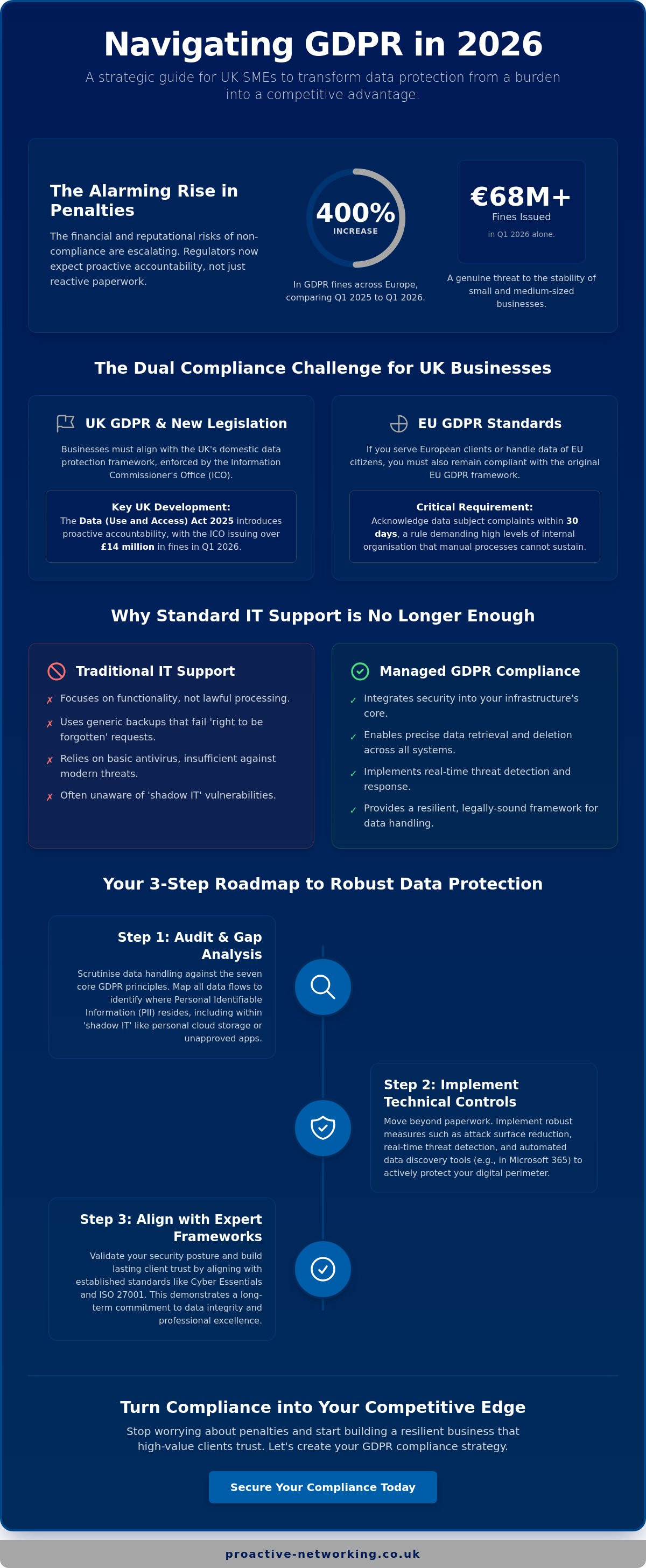
European data protection authorities imposed over €68 million in GDPR fines in the first quarter of 2026, which represents a nearly 400% increase from the same period in 2025. For many small business owners, these figures aren't just abstract statistics; they represent a genuine threat to operational stability. With the recent implementation of the Data (Use and Access) Act 2025, the complexity of maintaining lawful data processing has reached a new peak. You likely feel the pressure of balancing UK GDPR requirements against EU standards whilst worrying about technical vulnerabilities. Finding reliable gdpr compliance support often feels like a choice between exhaustive manual paperwork or the constant fear of a significant data breach.
We understand that you want to move past the anxiety of regulatory penalties and focus on your core operations. This article demonstrates how to transform GDPR from a restrictive burden into a robust technical framework that secures your data and enhances your professional reputation. We will provide a clear roadmap to compliance that reduces your risk, validates your security through expert standards, and builds lasting trust with your high value clients. By the end of this guide, you will have the strategic foresight needed to turn data protection into a competitive advantage.
Key Takeaways
Understand the essential differences between UK and EU regulations and why a managed approach is the most efficient way to maintain data integrity.
Learn how to conduct a thorough gap analysis by mapping data flows and identifying where your most sensitive personal identifiable information resides.
Move beyond basic paperwork by implementing technical controls such as attack surface reduction and real time threat detection.
Explore how tailored gdpr compliance support helps solicitors, barristers and financial professionals meet their unique industry obligations.
Discover the benefits of aligning your data protection strategy with established frameworks like Cyber Essentials and ISO 27001 to ensure long term security.
Table of Contents
Understanding GDPR Compliance Support for UK SMEs in 2026
Effective gdpr compliance support has evolved from a static checklist into a dynamic managed service focused on long term data integrity. It isn't enough to simply have a privacy policy on your website. True compliance involves a sophisticated blend of administrative oversight and technical guardianship. Whilst the General Data Protection Regulation established the global standard, the UK's departure from the EU created a dual framework. British businesses must now align with the UK GDPR whilst remaining mindful of EU standards if they serve European clients. By 2026, this landscape has become significantly more technical. A Data Protection Officer provides the necessary legal oversight, but they often lack the technical tools to prevent a breach. This is where a technical compliance partner becomes essential, acting as a steady leader to secure your digital perimeter.
The Evolving Regulatory Landscape in the UK
The Data (Use and Access) Act 2025, which saw key provisions come into force on 5 February 2026, represents the most significant shift in British data law for years. The Information Commissioner's Office (ICO) has moved away from simple reporting toward a model of proactive accountability. In the first quarter of 2026 alone, the ICO was responsible for over £14 million in fines. This aggressive enforcement highlights a new reality: the regulator expects SMEs to demonstrate active control over their data. As of 19 June 2026, data subjects also have a specific right to complain directly to controllers, who must acknowledge these concerns within 30 days. This requires a level of organisation that manual processes simply cannot sustain.
Why Traditional IT Support Often Fails GDPR Tests
Many businesses mistakenly believe that standard IT support equates to being compliant. There is a vast difference between working IT and compliant IT. A generic backup strategy might keep your files safe, but it often fails the GDPR test if it cannot facilitate a precise right to be forgotten request across all archives. Basic antivirus software is equally insufficient. With 43% of UK businesses reporting a breach in the last year, relying on legacy tools is a significant risk. Professional gdpr compliance support integrates security into the very fabric of your infrastructure, ensuring that your behaviour as a data controller is both lawful and resilient. This approach bridges the gap between basic functionality and the high tier standards required to protect your reputation.
The GDPR Audit and Gap Analysis: Identifying Your Risks
A robust audit serves as the primary defensive layer for your organisation. It moves beyond superficial checks to scrutinise how your business handles information at every stage of its lifecycle. By evaluating your current controls against the seven core GDPR principles, you can identify precisely where your security posture requires reinforcement. This process is often where the value of professional gdpr compliance support becomes most apparent. It provides the clarity needed to transition from uncertainty to a state of controlled, documented integrity. Without a clear starting point, even the most expensive security tools may be misapplied, leaving critical vulnerabilities exposed.
Mapping your data flows is the first practical step in this journey. You must understand where personal identifiable information (PII) resides, whether it is in structured databases or hidden within shadow IT silos. Unauthorised use of personal cloud storage or unapproved messaging apps by employees can create significant vulnerabilities that bypass standard security protocols. Utilising the NIST Privacy Framework allows your business to adopt a risk based approach to managing these privacy risks, ensuring that your technical controls align with global best practices.
Data Mapping and Inventory Management
Identifying all sources of PII across a modern network requires more than a manual search. In Microsoft 365 environments, automated discovery tools can scan SharePoint, OneDrive and Exchange to flag sensitive data that has been stored incorrectly. Documenting these findings is essential for creating valid data retention and disposal policies. A clear inventory ensures that you only keep what you need. This directly supports the principle of data minimisation and reduces your overall liability in the event of an incident.
Risk Assessment for Third Party Vendors
Your compliance is only as strong as the weakest link in your supply chain. You must evaluate the data protection standards of every cloud provider and software partner you engage. This requires formal Data Processing Agreements (DPAs) to define responsibilities clearly. Under the Data (Use and Access) Act 2025, transferring data outside the UK now involves a Data Protection Test to ensure the recipient country's laws are not materially lower than our own. Expert gdpr compliance support ensures that these agreements are not merely signed but actively enforced through regular vendor reviews.
Establishing a roadmap for cyber security compliance services UK allows you to prioritise remediation steps based on actual business impact. By addressing high risk gaps first, you achieve a rapid reduction in your breach exposure whilst building a foundation for more advanced standards like ISO 27001. If you require assistance in navigating these complex requirements, our team at Proactive Networking can provide the expert validation your business needs to operate with confidence.
Technical Measures for Data Protection: Beyond the Paperwork
A policy document alone cannot stop a data breach. Whilst an audit identifies your risks, technical controls provide the functional barrier that keeps sensitive information within your perimeter. GDPR requires businesses to implement technical and organisational measures that ensure a level of security appropriate to the risk. This often necessitates a move toward state of the art solutions that detect threats before they escalate into reportable incidents. Professional gdpr compliance support focuses on this implementation phase, ensuring your infrastructure is resilient enough to withstand modern cyber attacks. By securing the attack surface and optimising your existing software, you create a robust framework that protects both your clients and your reputation.
Encryption remains a fundamental requirement for data at rest and data in transit. It ensures that even if a physical device is lost or a data packet is intercepted, the information remains unintelligible to unauthorised parties. For many SMEs, Microsoft 365 licensing offers a powerful suite of tools for advanced data governance, but these features must be correctly configured to be effective. Optimising your setup allows for automated sensitivity labelling and data loss prevention (DLP) policies that prevent employees from accidentally sharing PII outside the organisation.
Endpoint Detection and Response (EDR) as a GDPR Shield
Modern threats move too quickly for traditional antivirus to manage. EDR and XDR solutions provide real time visibility into your network, monitoring user behaviour to identify anomalies that suggest a potential internal breach or external infiltration. These systems satisfy the GDPR requirement for proactive security by automating the response to malware. If an endpoint is compromised, the system can isolate the device immediately, preventing the lateral movement of threats toward your core databases. This level of automation is essential for maintaining the state of the art standard expected by the ICO.
Identity and Access Management (IAM) Best Practices
Restricting data access is a core principle of data protection. You should operate on the principle of least privilege, ensuring staff only have access to the specific data required for their roles. Multi factor authentication is now a non negotiable standard for securing sign ins. Alongside this, conditional access policies can be used to manage remote workers, ensuring that data is only accessible from compliant devices and recognised locations. These measures significantly reduce the risk of credential theft leading to a catastrophic data loss.
Resilience Through Managed Data Backups
GDPR specifically mandates the ability to restore the availability and access to personal data in a timely manner following a technical incident. Simple backups are no longer sufficient; you need true data resilience. This involves regular testing of your business continuity plan to ensure that your recovery time objectives (RTOs) meet regulatory standards. A managed backup solution ensures that your data is not only stored securely but is also verified and ready for rapid restoration if your primary systems fail. This proactive approach transforms gdpr compliance support from a reactive necessity into a strategic asset for your business operations.
Industry-Specific GDPR Requirements: Legal, Finance and Education
Every industry operates under the same broad regulations, but the practical application of data law varies significantly between sectors. A generic approach often overlooks the nuanced requirements of high stakes environments like legal chambers or financial firms. Specialist gdpr compliance support simplifies the audit process by focusing on the specific regulatory overlaps that affect your daily operations. This ensures that your technical framework isn't just legally sound but also operationally efficient. By aligning your IT infrastructure with sector specific expectations, you demonstrate a level of sophistication that builds trust with high value clients.
For Solicitors and Barristers, client confidentiality is a professional mandate that predates modern data law. However, the digitalisation of case files has introduced new vulnerabilities that require a more robust technical response. Managing sensitive data during company data mergers requires meticulous oversight to prevent the accidental disclosure of privileged information. High tier encryption standards are essential for all communications between legal professionals and their clients to maintain the integrity of the solicitor client relationship.
High Tier Protection for the Legal Sector
Barristers Chambers and sole practitioners face unique challenges, particularly when managing data across multiple devices and locations. You must ensure that your behaviour as a data controller remains beyond reproach, even when working remotely. Implementing robust access controls ensures that case data is only accessible to authorised personnel, directly supporting your professional obligations whilst meeting statutory requirements. This proactive stance protects your reputation from the fallout of a potential data leak.
GDPR in the Financial and Education Sectors
In the financial sector, compliance isn't a standalone effort. It involves merging GDPR principles with strict FCA data standards. You must protect financial records whilst maintaining clear, immutable audit trails for regulators. This dual layer of accountability requires a sophisticated technical approach that secures transactions without hindering the speed of your service delivery. It's about creating a steady, dependable environment where data integrity is guaranteed.
Educational leaders carry the additional responsibility of safeguarding student data whilst meeting Department for Education (DfE) standards. Managing Subject Access Requests (SARs) in schools can be particularly time consuming, requiring a proactive strategy to locate and redact information quickly. This is where automated data discovery tools prove their value. For a deeper look at these requirements, our guide on cyber security for schools UK provides a comprehensive roadmap for educational compliance.
If you operate in these regulated sectors and require tailored gdpr compliance support, our specialists at Proactive Networking can help you navigate these complex requirements with confidence. We provide the expert validation needed to transform regulatory pressure into a strategic advantage for your organisation.
Implementing a Managed GDPR Strategy with Proactive Networking
Adopting a managed approach to data protection ensures that your business remains resilient in an era of aggressive regulatory enforcement. Compliance shouldn't be viewed as a one off project but as a continuous state of operational excellence. By integrating gdpr compliance support into your daily IT maintenance and monitoring, you move away from the anxiety of annual reviews toward a model of constant readiness. This proactive strategy allows for the immediate detection of vulnerabilities, ensuring that your security posture evolves alongside emerging threats. A long term partnership with a seasoned technical consultant provides the stability needed to navigate complex data landscapes without disrupting your core productivity.
Effective data governance requires more than just following the law; it demands a structured framework that validates your security efforts. Relying on 25 years of IT infrastructure experience, we understand that true protection is built on layers of proven standards. These frameworks provide a clear roadmap for SMEs to demonstrate their commitment to data integrity to both regulators and high value clients. When compliance is woven into the fabric of your IT operations, it ceases to be a regulatory burden and becomes a powerful asset for business growth.
The Synergy of Cyber Essentials and GDPR
Cyber Essentials serves as the ideal starting point for any technical compliance journey. This government backed standard focuses on five key technical controls that, when implemented correctly, can prevent the vast majority of common cyber attacks. It provides a foundational layer of protection that aligns perfectly with the GDPR requirement for state of the art security. For businesses deciding on the right path forward, it is helpful to evaluate the differences between cyber essentials vs iso 27001 to determine which standard best suits your current operational scale. Achieving this certification demonstrates a clear, verified commitment to protecting sensitive information.
Achieving the Gold Standard with ISO 27001
For organisations managing complex data environments or those operating in highly regulated sectors, ISO 27001 represents the international gold standard for information security. This framework goes beyond technical controls to establish a comprehensive Information Security Management System. Our iso 27001 implementation support helps you build a culture of security that scales with your business. Holding this accreditation provides a significant competitive advantage, offering peace of mind to stakeholders whilst ensuring that your gdpr compliance support is backed by a globally recognised methodology.
Taking the next step toward a secure future begins with understanding your current position. A comprehensive GDPR and security audit provides the clarity needed to identify risks and prioritise remediation. If you are ready to transform your data protection strategy from a manual burden into a robust technical framework, Proactive Networking is here to guide you. Our team provides the expert validation and strategic oversight required to secure your operations and protect your professional reputation for the long term.
Securing Your Digital Future with Confidence
Transforming your data protection strategy requires a shift from viewing compliance as a hurdle to seeing it as a technical foundation for growth. We've explored how proactive monitoring, robust encryption and sector specific frameworks like ISO 27001 protect your reputation whilst satisfying the ICO's evolving standards. By moving beyond manual paperwork and adopting real time threat detection, you ensure your business remains resilient against the sophisticated cyber attacks of 2026. Managing these technical complexities doesn't have to be an internal burden for your staff.
With over 25 years of IT and security experience, our team acts as a steady guardian for your operations. We are specialists in Legal and Finance sector compliance and serve as ISO 27001 and Cyber Essentials certified practitioners. When you choose to secure your business data with professional gdpr compliance support from Proactive Networking Ltd, you gain a partner that simplifies the technical landscape. You can focus on your high value clients whilst we maintain the absolute integrity of your data infrastructure. Let us help you turn regulatory requirements into a long term competitive advantage. Your path to peace of mind starts with a single, strategic step forward.
Frequently Asked Questions
What is the difference between a GDPR audit and a gap analysis?
A GDPR audit is a formal examination of your current data processing activities to verify existing compliance levels against statutory requirements. In contrast, a gap analysis focuses on identifying the specific discrepancies between your current operations and the required regulatory standards. This results in a prioritised action plan to address vulnerabilities, ensuring that your technical and organisational measures are fully aligned with the Data Protection Act 2018.
Does my small UK business really need a Data Protection Officer?
You only require a Data Protection Officer if your organisation is a public authority or if you carry out large scale systematic monitoring or process sensitive data on a significant scale. Most small businesses don't meet these criteria, but many choose to appoint an external partner for specialist gdpr compliance support. This provides the expertise of a qualified professional without the overhead of a full time hire, ensuring your data handling remains lawful and secure.
How much does GDPR compliance support typically cost for an SME?
The cost of compliance support varies based on the complexity of your data environment and the volume of personal identifiable information you manage. Professional services are typically structured around the specific needs of your sector, such as legal or finance, where data sensitivity is inherently higher. Investing in a managed strategy is generally more cost effective than facing the financial penalties and reputational damage associated with a reportable data breach.
Can Microsoft 365 make my business fully GDPR compliant?
Microsoft 365 provides powerful tools for data governance, but it doesn't guarantee compliance by default. You must correctly configure features like data loss prevention, sensitivity labelling and multi factor authentication to meet regulatory standards. Effective gdpr compliance support ensures these technical controls are optimised to protect your specific data flows. Software tools are only as effective as the strategic framework that governs their daily use.
What happens if we suffer a data breach whilst under a support contract?
If a breach occurs, your support partner will immediately activate your incident response plan to contain the threat and assess the risk to data subjects. Under UK law, you must notify the ICO within a 72 hour window if the breach is likely to result in a risk to individuals' rights and freedoms. Having a managed service ensures that you have the forensic evidence and technical documentation required to demonstrate proactive accountability during a regulatory investigation.
How often should we review our GDPR policies and technical controls?
You should review your policies and technical controls at least annually or whenever significant changes occur within your IT infrastructure. Major regulatory shifts or the adoption of new cloud technologies also necessitate an immediate review of existing procedures. Regular audits ensure that your data protection measures remain effective against evolving cyber security threats and continue to meet the high tier standards expected by your clients.
Does GDPR apply to my business if I only have B2B clients?
GDPR applies to any business that processes personal data, including the contact details and email addresses of individuals at your B2B clients. Whilst you may not handle consumer data, you still manage the personal identifiable information of employees, partners and suppliers. These individuals have the same rights under the law, meaning your organisation must maintain rigorous standards of data integrity and security regardless of your business model.
What is the first step to take if I suspect our data protection is inadequate?
The first step is to conduct a professional gap analysis to identify your most critical technical and administrative vulnerabilities. This provides a clear baseline of your current security posture and allows you to prioritise remediation based on actual business impact. Early intervention is essential to prevent minor technical oversights from escalating into significant data breaches. Seeking expert validation ensures that your roadmap to compliance is both practical and legally robust.


Comments