


Failover Internet Solutions for Business: A Strategic Roundup for UK SMEs in 2026
- Simon Raine
- 3 days ago
- 13 min read
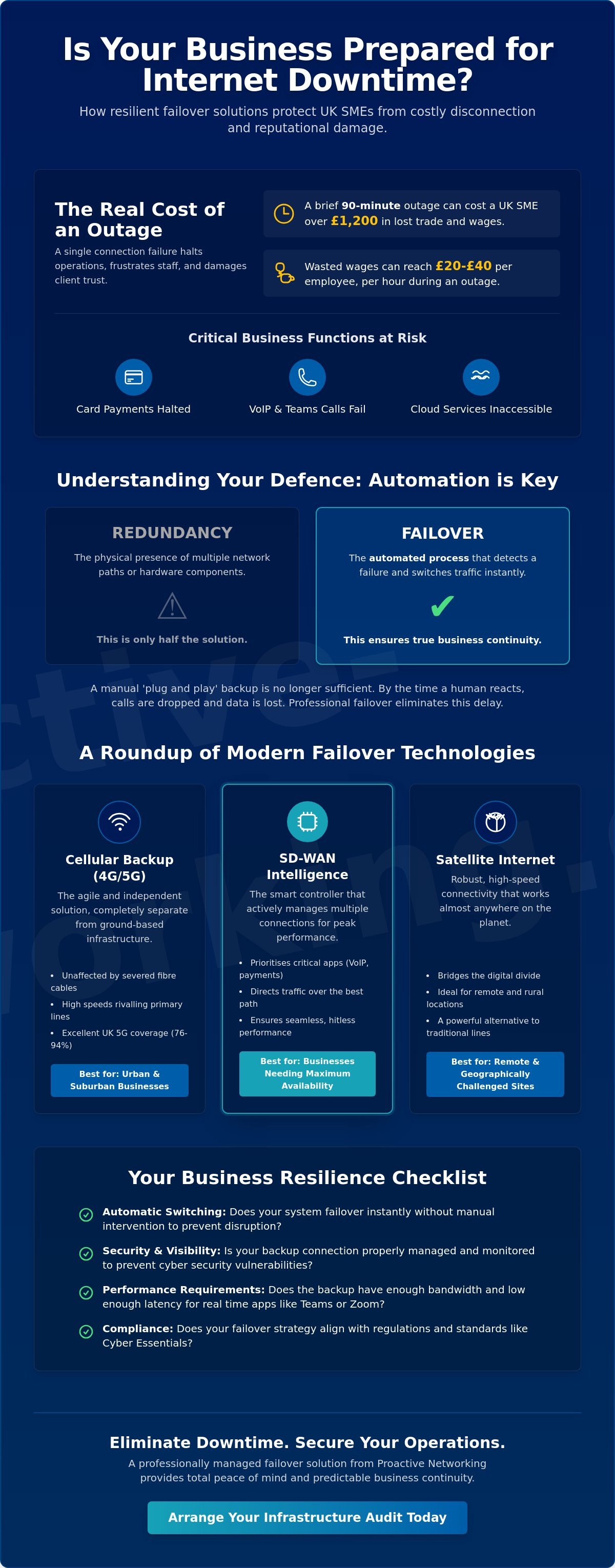
Could a brief 90-minute internet outage really cost your business upwards of £1,200 in lost trade and wasted wages? For many UK SMEs in 2026, a single connection failure is no longer just a minor inconvenience; it's a significant financial risk that halts card payments, disrupts VoIP calls, and severs access to vital cloud services. You likely recognise that consistent connectivity is the foundation of your daily operations, yet the frustration of unreliable signals or the anxiety of a sudden line fault remains a persistent concern for many directors.
This strategic roundup explores the most resilient failover internet solutions for business, designed to eliminate downtime whilst maintaining the high security standards your clients expect. We'll examine how modern 5G standalone backups and satellite technologies provide a dependable safety net for your digital infrastructure. You will also discover how these solutions integrate with the latest Cyber Essentials v3.3 Danzell requirements, ensuring your business remains both connected and compliant in an increasingly demanding landscape. By the end of this guide, you'll have a clear roadmap to achieving predictable business continuity and total peace of mind.
Key Takeaways
Understand the critical differences between 4G, 5G, and secondary fixed lines to select the most resilient backup for your specific location.
Learn how modern failover internet solutions for business provide automatic switching to eliminate the financial impact of downtime.
Identify why unmanaged backup lines can compromise your cyber security and how to maintain visibility across all connections.
Determine your bandwidth and latency requirements to ensure real time applications like Teams or Zoom remain operational during an outage.
Discover how a comprehensive infrastructure audit can pinpoint single points of failure before they disrupt your business operations.
Table of Contents
Why Business Continuity Depends on Internet Resilience in 2026
In 2026, a stable internet connection serves as the central nervous system of any successful enterprise. We've moved well beyond the era where a downed line merely meant a quiet afternoon; in a cloud-first environment, it represents a complete operational standstill. This is why failover internet solutions for business have transitioned from a luxury for large corporations to a fundamental requirement for UK SMEs. Failover is a proactive mechanism designed to detect a primary connection failure and automatically switch traffic to a standby line without manual intervention. It's the difference between a seamless transition and a frantic scramble to find a working signal.
The "always-on" expectation amongst clients has turned downtime into a significant reputational risk. When your digital doors are locked, clients don't just see a technical glitch; they see a lack of professional foresight. Transitioning from a reactive "break-fix" approach to a managed resilience model ensures that your business remains accessible, regardless of local infrastructure faults or provider outages. It allows you to maintain control over your operations rather than being at the mercy of external service providers.
The Real Cost of Downtime for UK SMEs
The financial impact of an outage is often far higher than business owners initially estimate. For a typical UK office with 20 staff members, an outage can cost between £20 and £40 per employee per hour in lost wages alone, as teams are left unable to access Microsoft 365 or collaborate on shared projects. Beyond staff costs, the disruption to communication is severe. Modern VoIP and Teams-based phone systems rely entirely on stable connectivity; if the internet fails, your clients can't reach you. Furthermore, many UK industries now face strict regulatory requirements regarding data availability. An extended outage could lead to a breach of compliance standards, particularly if client data remains inaccessible during critical periods.
Failover vs. Redundancy: Clearing the Confusion
It's vital to distinguish between these two concepts to build a truly resilient network. Redundancy refers to the physical presence of multiple paths or hardware components within your infrastructure. In contrast, failover is the automated process that manages the switch between these paths. Having a secondary line is redundant, but without an automated failover system, your staff must still manually swap cables or reconfigure routers, leading to significant delays.
A manual "plug and play" backup is no longer sufficient for modern offices. By the time a human operator notices the failure and makes the switch, active sessions are dropped, VoIP calls are disconnected, and cloud synchronisation is interrupted. Professional failover internet solutions for business eliminate this lag, providing a sophisticated layer of protection that keeps your systems online and your data moving without a second of hesitation.
A Roundup of Modern Failover Internet Technologies
Selecting the right connectivity mix is essential for maintaining a resilient operation. In 2026, failover internet solutions for business have evolved significantly, moving past simple secondary cables to intelligent, multi-path systems. Whether you're an urban office or a rural workshop, the technology now exists to ensure you never lose a minute of productivity. The current market offers a variety of paths to resilience, from cellular backups to advanced satellite arrays.
For many UK SMEs, 4G and 5G cellular backups remain the preferred choice because they're physically independent from ground-based infrastructure. If a local construction crew accidentally severs your primary fibre optic cable, a cellular link remains unaffected. With 5G coverage now reaching between 76% and 94% of premises from individual operators, these systems offer speeds that often rival primary lines. For businesses requiring the highest availability, SD-WAN (Software-Defined Wide Area Network) technology acts as an intelligent conductor. It manages multiple connections simultaneously, directing critical traffic like VoIP or payment processing over the most stable path available at any given millisecond.
In more remote regions where traditional infrastructure is limited, satellite services like Starlink have become a viable alternative. This technology has effectively bridged the digital divide, ensuring that even the most isolated premises can maintain a robust connection. When evaluating these technologies, it's often beneficial to work with a partner who can provide tailored broadband and backup lines suited to your specific geographic location.
Cellular Resilience: 4G vs. 5G Standalone
The transition to 5G Standalone (SA) in 2026 has been a game changer for business continuity. Unlike earlier 5G versions that relied on 4G cores, 5G SA provides significantly lower latency, which is vital for clear Teams calls and real time data synchronisation. To ensure maximum reliability, we often recommend external high-gain antennas. These devices bypass thick office walls to capture a stronger signal from the nearest mast. It's also vital to monitor data caps on SIM-based systems; unmanaged failover can lead to substantial bill shock if a primary outage goes unnoticed for several days.
Fixed-Line Diversity
True resilience requires more than just two cables; it requires carrier diversity. Relying on two different providers that both use the Openreach network creates a single point of failure at the local exchange. A more sophisticated approach involves pairing an Openreach-based line with a Virgin Media connection or a private leased line. This "diverse routing" ensures that your backup remains live even if a major provider suffers a regional backbone failure. With the PSTN switch-off now complete in 2026, all backup lines have transitioned to digital SoGEA or FTTP circuits, making professional configuration more important than ever to ensure seamless failover internet solutions for business.
Evaluating the Best Failover Options for Your SME
Selecting the most effective failover internet solutions for business involves more than a simple price comparison. You must first quantify your Recovery Time Objective (RTO), which is the maximum duration your business can tolerate being offline. For most modern UK SMEs in 2026, this target is now near-zero. Achieving this requires a deep dive into your bandwidth requirements during an outage. Whilst your primary line might support 1Gbps, your backup might only offer 50Mbps. You need to determine if that capacity can sustain your essential cloud applications and communication tools without causing a bottleneck.
Latency sensitivity is another critical factor. Real time applications like Teams or Zoom require low latency connections to function correctly. If your backup solution introduces significant lag, your voice calls will jitter and video will freeze, regardless of how much raw bandwidth you have. Additionally, consider the Total Cost of Ownership (TCO). A cellular backup often has a lower entry cost but carries the risk of high data charges if a primary outage lasts for several days. When evaluating failover internet solutions for business, the balance between performance and predictability is paramount.
Bandwidth Prioritisation Whilst on Backup
To manage limited capacity effectively, you must implement Quality of Service (QoS) rules. These configurations allow your network to recognise and prioritise business-critical traffic, such as VoIP and payment processing, over non-essential activities like generic web browsing or software updates. Automated traffic shaping ensures that even if your backup line is under heavy load, your most important applications stay live. This granular control is essential for maintaining a professional image when your primary infrastructure fails.
Hardware Considerations: Routers and Firewalls
The hardware at the edge of your network is the brain of your failover strategy. Dual WAN routers are designed to handle two or more internet connections, monitoring the health of each line in real time. However, your firewall must also be failover aware. If your security appliance doesn't recognise the switch to a secondary line, it may block traffic or fail to maintain the encrypted tunnels required for remote work. Opting for a managed hardware approach provides the benefit of 24/7 monitoring, ensuring that hardware faults are identified and resolved before they can impact your connectivity.
Integrating Failover into Your Cyber Security and Compliance Strategy
Resilience and security are two sides of the same coin. Whilst many organisations view failover internet solutions for business primarily as an uptime tool, their role in maintaining a robust security posture is equally critical. A common pitfall for UK SMEs is the use of unmanaged backup lines, such as a staff member plugging in a consumer 4G dongle during an outage. These "shadow IT" connections often bypass the corporate firewall entirely, creating an unmonitored backdoor into your network. Professional failover ensures that every byte of data, regardless of the path it takes, remains subject to your primary security protocols and encrypted tunnels.
Maintaining visibility across all active connections is a cornerstone of modern threat detection. Your Endpoint Detection and Response (EDR) and Extended Detection and Response (XDR) tools must remain functional when your network switches to a secondary line. If your security stack loses its "eyes" during a failover event, you become vulnerable to lateral movement from attackers who capitalise on the momentary chaos of an outage. Sophisticated failover internet solutions for business are designed to be security-aware, ensuring that your protective umbrella remains fully deployed even when the primary infrastructure fails.
Adherence to international standards like ISO 27001 and the UK's Cyber Essentials scheme also demands high levels of availability. Under the April 2026 "Danzell" update to Cyber Essentials, the focus on managed cloud access has intensified. If you cannot guarantee secure, consistent access to your cloud services due to a lack of failover, you may find your certification at risk. To ensure your infrastructure meets these rigorous benchmarks, you should consider a professional review of your broadband and backup lines to identify potential compliance gaps.
Compliance for Regulated Sectors
For organisations in highly regulated fields, internet resilience is a non-negotiable requirement for data availability. We frequently provide specialist it support for solicitors where constant access to case management systems is vital for meeting court deadlines and GDPR obligations. Similarly, our managed it services for schools help educational institutions meet Department for Education (DfE) standards for digital resilience. In these sectors, an outage isn't just a loss of time; it's a failure to meet statutory duties regarding data protection and service delivery.
Securing the Remote and Hybrid Workforce
The modern perimeter now extends into the homes of your senior leadership team. Extending failover resilience to key home-based staff ensures that decision-makers remain online during local area faults. However, switching to a backup line often changes the network's public IP address. Without proactive configuration, this can trigger "impossible travel" alerts in your sign-in protection systems or block Multi-Factor Authentication (MFA) requests. A managed approach ensures that your identity protection remains seamless, allowing your team to stay productive without being locked out of their accounts during a failover event.
Implementing a Managed Failover Solution with Proactive Networking
Many providers treat failover internet solutions for business as a simple hardware purchase. At Proactive Networking Ltd, we view connectivity as a core component of your broader Business Continuity strategy. Our process begins with a comprehensive infrastructure audit to identify single points of failure that often go unnoticed, such as shared ducting or overlapping network exchanges. With over 25 years of experience in the industry, we've mastered the complexities of the UK's telecommunications landscape. We understand that true resilience isn't found in a box, but in the meticulous design and management of your entire network ecosystem.
We act as a protective guardian for your operations, ensuring that your technical infrastructure supports your commercial ambitions. By moving away from a fragmented approach where different vendors manage different lines, you gain a cohesive and stable environment. This structured methodology reinforces your brand's reliability, ensuring that your staff can remain productive and your clients can always reach you. Our seasoned experts handle the technical heavy lifting, making sophisticated mastery accessible to your leadership team.
Our Proactive Approach to Connectivity
We provide 24/7 infrastructure monitoring to detect and resolve primary line issues before they impact your staff. It's one thing to have a backup line; it's another to know it will actually work when needed. We conduct regular, scheduled testing of failover mechanisms to ensure 100% reliability. By integrating your broadband and backup lines into a single managed IT support contract, we eliminate the finger pointing between providers that often occurs during an outage. You gain a single point of contact and a partner who takes full responsibility for your uptime, allowing you to focus on your core business objectives whilst we safeguard your connectivity.
Take the Next Step Towards Business Resilience
Choosing a local UK partner provides more than just faster response times. It offers deep insight into the specific infrastructure challenges of your region and sector, from the busy streets of London to rural industrial estates. Whether you are scaling your operations or refining your existing setup, we align your technology roadmap with your long term business growth goals. This strategic foresight ensures your failover internet solutions for business evolve alongside your needs, providing a steady foundation for your digital future. We project an image of quiet competence, allowing you to operate with the confidence that your communication remains secure and accessible.
You don't have to navigate these technical complexities alone. Our team is ready to help you implement a robust, secure, and fully managed connectivity strategy that protects your revenue and your reputation. Protect your business from downtime with a managed failover solution.
Securing Your Digital Future with Resilience and Precision
Achieving total internet resilience in 2026 requires a strategic shift from reactive fixes to proactive, managed networking. We've explored how carrier diversity, 5G Standalone technology, and intelligent traffic prioritisation form the essential foundation of a modern network. By aligning these failover internet solutions for business with your wider security and compliance goals, you protect your revenue and ensure your reputation remains untarnished during local infrastructure failures. A manual backup is no longer a viable option for a professional enterprise; automation is the only way to guarantee the near-zero downtime that modern clients expect.
Proactive Networking Ltd brings over 25 years of experience in UK SME infrastructure to every partnership. As an ISO 27001 and Cyber Essentials accredited provider, we understand the specific regulatory pressures within the Legal, Finance, and Education sectors. We don't just provide backup lines; we offer a steady and dependable guardianship that simplifies the technical landscape for your leadership team. Our expertise ensures your connectivity remains a silent, stable engine for your continued growth.
Secure your business continuity with a managed failover solution from Proactive Networking Ltd. Take control of your connectivity today and operate with the confidence that your organisation is always online and fully protected.
Frequently Asked Questions
What is the difference between internet failover and a simple backup line?
Internet failover is the automated process of switching traffic, whereas a backup line is merely the secondary physical connection. Without a failover mechanism, your staff would need to manually swap cables or reconfigure settings during an outage. Professional failover internet solutions for business ensure this transition happens in seconds, maintaining your connection to cloud services and preventing operational downtime.
How much does a professional failover internet solution cost for a UK SME?
The total investment depends on the specific technologies required to meet your business continuity goals and geographic location. Costs typically include the initial hardware for dual-WAN management and the ongoing monthly subscription for the secondary line, whether that is a cellular, satellite, or fixed-line connection. We recommend viewing these costs as a strategic insurance policy against the significant financial impact of a primary line failure.
Will my IP address change when the system fails over to a secondary line?
Your public IP address will usually change when you switch to a secondary provider unless you use a managed service designed to route traffic through a consistent gateway. A changing IP can disrupt remote access, VPN tunnels, and certain security protocols. Our experts configure your hardware to handle these changes gracefully, ensuring your security perimeter remains intact even when your external identifier shifts.
Can I use a 5G SIM card as a reliable business failover solution?
A 5G SIM card is an exceptionally reliable component of failover internet solutions for business, provided it is supported by professional hardware. With 5G coverage now reaching the vast majority of UK business premises, it offers the high speeds and low latency necessary for modern office applications. We often pair these SIMs with external antennas to ensure signal stability is maintained regardless of your building's construction.
Does internet failover happen automatically or do I need to switch it manually?
Professional failover happens automatically through an intelligent router or SD-WAN appliance that monitors your primary connection's health in real time. The system detects a failure and reroutes traffic to the standby line without any human intervention. This automation is vital for preserving active VoIP calls and ensuring that cloud-based synchronisation is not interrupted by the sudden loss of the primary circuit.
What hardware do I need to support a dual-WAN failover setup?
You require a dual-WAN router or a dedicated security appliance capable of managing multiple internet gateways simultaneously. This hardware must possess the processing power to maintain your firewall rules and encryption standards across different connection types. Depending on your backup choice, you may also need a 5G modem or a satellite terminal to interface with the secondary network provider.
Is a satellite connection like Starlink suitable for business failover?
Starlink is a highly effective failover option, particularly for UK businesses in rural areas or locations with poor cellular reception. Its low-earth orbit technology provides the low latency required for Teams and Zoom calls, which traditional satellite services often struggle to support. It offers true physical diversity, as the signal comes from above rather than through the same ground-based ducts as your primary line.
How does failover internet affect my business VoIP phone system?
A correctly configured failover system ensures your VoIP phones remain operational, although a live call may experience a brief interruption during the initial switch. By implementing Quality of Service (QoS) rules, we ensure that voice data is prioritised on your backup line. This prevents call quality issues like jitter or lag, even if the secondary connection has less total bandwidth than your primary fibre line.


Comments